
模型与 MCP
待识别

rea
morluto
Reverse engineer anything with agents, from app behavior down to native binaries.
PROJECT TOPICS
INSTALL REFERENCE
dsh plugin --profile web add github:Edison-A-N/dsh-session-journal
该命令指向仓库当前默认分支;尚无绑定当前 commit 的完整验证结果。
PROJECT README
A DeepSeek Harness (DSH) Web plugin that keeps a work journal for each session in the right sidebar. Long sessions scroll away: requirements were discussed, code was written, reviewed three times, fixed and tested, and by then the start is far out of view. The journal shows what the session has worked on, where each piece of work stands, and lets you jump back to any turn in the chat.
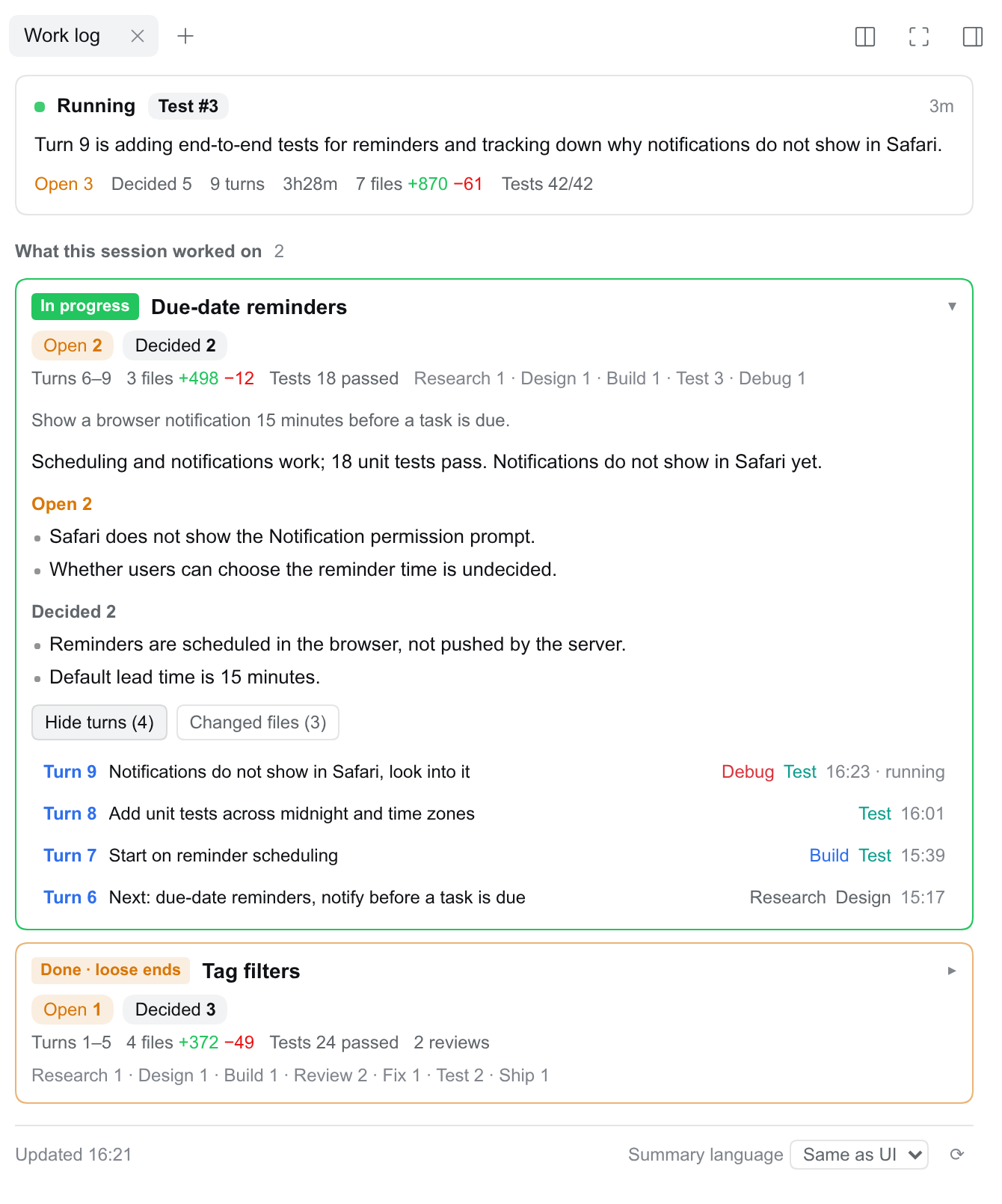
Review #2), a one-line status, and a highlighted "Your turn" box when the agent stopped to wait for you. Totals for the session: open items, decisions, turns, time, changed files and lines, tests passed.Open a session and pick Work log on the right sidebar's start page, or click the chip next to the session title. Expand a work item to see its open items and decisions; open Jump to a turn and click a row to scroll the chat to that turn. Change the summary language in the panel footer.
Facts come from the session log; a model only labels and summarizes.
lib/collector.js): the plugin reads the session's append-only event log through DSH's sessionQuery service, so compacted history is still there. Per turn it extracts the user's message, every tool call, file edits with line counts, test commands and their exit codes, review delegations, questions to the user, and the todo list.lib/summarizer.js): each finished turn is summarized once by a model into phases (from a fixed list: requirements, research, design, build, review, fix, test, debug, ship, discussion), a short title and result per phase, the decisions made, and what was left open. Text the user pasted from elsewhere (another session's panel, logs, someone else's message) is treated as material, not as a request.lib/outline.js): once every finished turn has a summary, one more call groups the turns into 1 to 6 work items and writes each item's status, result, open items and decisions. It sees the whole session, so problems solved in later turns do not linger as open. It is redone when the summaries change, which is about one call per new turn.lib/autoupdate.js): as soon as a session's turn ends, that session's journal is updated in the background: the finished turn is summarized, then the work items are regrouped. The plugin keeps checking that session every few seconds, as an open panel would, until nothing is left to do, so a failed summary is tried again after a minute (three attempts in all) without anyone opening the panel. It gives up after five minutes without progress, or thirty in total. Only the session whose turn ended is touched, in one summary language: the one it was last viewed in, else the language of its existing cache, else the language last viewed in the panel (remembered across restarts). Subagent and teammate sessions are skipped; their parent session records the delegation.lib/store.js): summaries and the outline are stored per session and per summary language under $DSH_HOME/storages/session-journal/, so each turn is summarized once and switching languages back is instant.lib/webapi.js): GET /plugins/session-journal/api/journal?session=<id>&lang=zh|en, behind DSH's login check. The browser polls it every 4 s while the session runs or summaries are pending, every 20 s otherwise.Without a model the journal still works: phases come from rules (edits, tests, reviews) and the whole session is one work item.
By default each session is summarized with that session's own provider and model. Summary calls are separate requests with their own small context; they never touch the conversation or its cache. Costs, roughly: one call per finished turn (a few thousand input tokens), and one outline call per new turn (5k to 20k input tokens on long sessions). In the background, only sessions that are being worked on cost anything; idle sessions are not touched (opening the panel on one still summarizes any turns it lacks). The first turn to end after installing or upgrading the plugin also summarizes that session's earlier turns that have no summary yet, and so does the first turn of a forked session, for the turns it inherited.
To use one fixed, usually cheaper, model for every session, set both SESSION_JOURNAL_PROVIDER and SESSION_JOURNAL_MODEL in DSH's launch environment (for example $DSH_HOME/.env); setting only one of them has no effect:
SESSION_JOURNAL_PROVIDER=<provider id>
SESSION_JOURNAL_MODEL=<model id>
SESSION_JOURNAL_EFFORT=low        # reasoning effort; "default" leaves it to the route
# SESSION_JOURNAL_MODEL=off       # no model calls, rules only
Restart DSH after changing them.
DSH has no public "scroll to turn" API for plugins. The chat view has its own turn rail, a row of ticks at the right edge of the transcript, one per turn. The journal finds the tick for the turn and clicks it, so the chat does the scrolling and any history loading itself.
DSH >=0.2.2-alpha.2 <0.3.0-0 (0.2.x, including its prereleases), Node >=22.19.
dsh plugin --profile web add github:Edison-A-N/dsh-session-journalThe package ships its own bundle patch (dsh.bundle.patch + cordis.patch.yml), so the CLI and the Web UI's Plugins page load it in one step. Restart DSH, reload the page, open a session, and pick Work log on the right sidebar's start page (or click the chip in the session header).
pnpm install
pnpm run build   # bundles client/src into lib/client.js
pnpm test
lib/client.js is committed, because DSH loads it as-is; rebuild it in the same commit as any change under client/src.
Bug reports and pull requests are welcome on GitHub. Please include the DSH version, the browser, and what the panel showed.
MIT.
CLASSIFICATION EVIDENCE
系统优先读取 GitHub Topics,再与站内分类词典和词根规则比对。当前命中: deepseek-harness。
morluto
Reverse engineer anything with agents, from app behavior down to native binaries.

deepseek-ai
DeepSeek Harness: Everything is a Plugin.

nexu-io
The 1st Collaborative AI Design Agent Workspace. Local-first and open source. Create motion, prototypes, websites, apps, dashboards, presentations, images, and videos with your team and AI agents. Share work, exchange feedback, and iterate together in one workspace.