

模型与 MCP
待识别

rea
morluto
Reverse engineer anything with agents, from app behavior down to native binaries.
PROJECT TOPICS
INSTALL REFERENCE
dsh plugin --profile web add github:Dynesshely/dsh-plugin-btw
该命令指向仓库当前默认分支;尚无绑定当前 commit 的完整验证结果。
PROJECT README
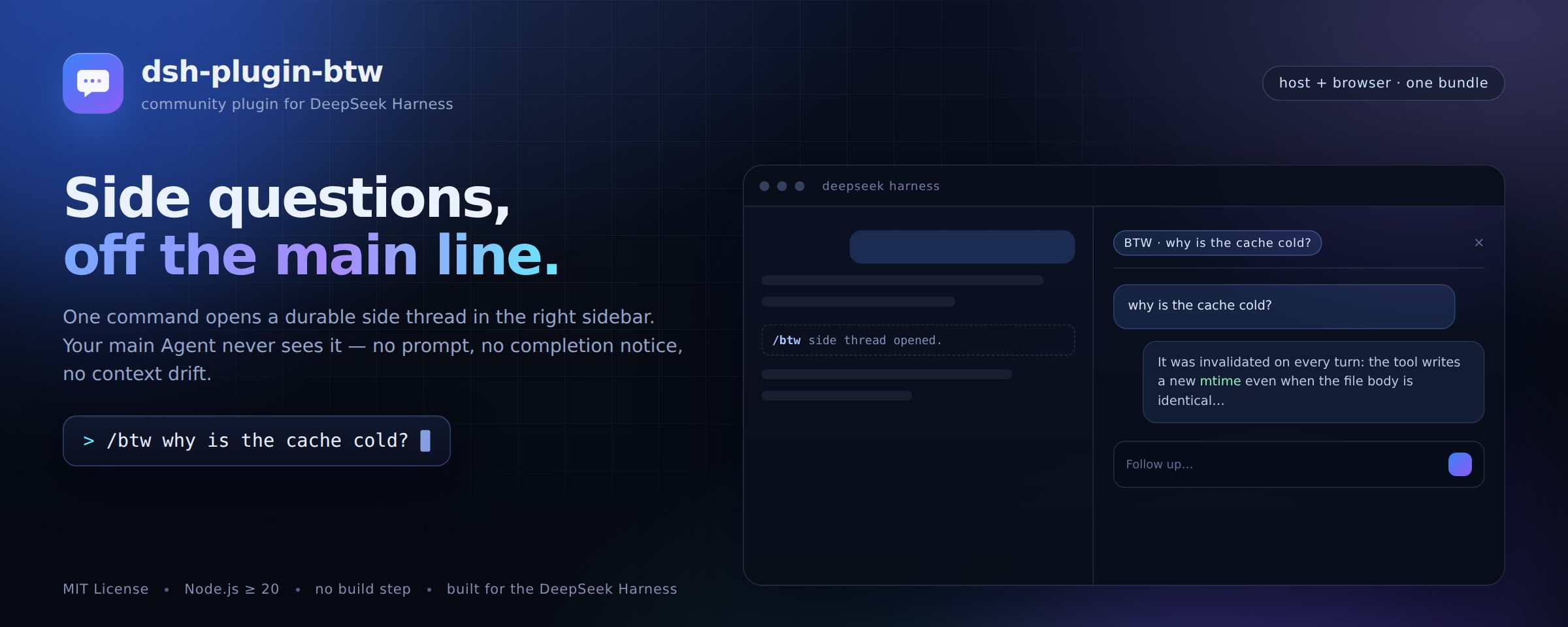
Ask a side question in DeepSeek Harness without touching the main conversation.
One command opens a durable side thread in the right sidebar. The main Agent never sees it.




/btw is for the question that is about the work but not part of it: "why is this cache cold?",
"what does this flag do?", "can you check whether that file is still generated?". It runs in its own
durable thread, inherits the conversation's completed turns, and answers in the right sidebar while
the main thread keeps its context, token budget, and attention untouched.
| Command | Behavior |
|---|---|
/btw <question> |
Continue the newest idle /btw thread of this conversation, or open a new one. |
/btw new <question> |
Always open a fresh side thread. |
/btw |
Prints the usage hint; nothing is sent. |
The target thread opens in the right sidebar automatically and stays docked next to the main conversation. Its own composer handles follow-ups and Stop; the thread remains reachable from the conversation header's subagent catalog after the tab is closed.
caller delivery, so the main Agent
receives no completion notice. Every later turn cold-resumes the durable child; the plugin filters
the runtime's settlement notice out of the parent inbox before it can become a user message./btw command row, never the question
or the answer.The side thread is deliberately not sandboxed from the workspace: it inherits the conversation's
preset, model, permission roots, and working directory, so a /btw can also perform a small
operation. Approvals it raises render in its own tab.
/btw again).dsh web, or the Desktop app (the same surface).subagents service with the fork provider
(@deepseek-ai/dsh-subagent-fork-in-process, providerName: fork), which the
@deepseek-ai/dsh-base bundle mounts by default.btw) and ships its browser half in the same package./btw in any conversation.The same installation is available to an agent through the plugin manager tool:
plugin_manager install_bundle target=/absolute/path/to/dsh-plugin-btwThe result reports application: applied when the host row activates; the browser half appears after
the next page load. A first install of a new bundle does not require restarting the Harness process.
/btw should appear in the / command menu with its description. Send:
/btw what is this repository's license?The right sidebar should open a BTW · what is this repository's license? tab and stream the answer,
while the main conversation shows only a btw · Side thread opened. row.
Plain ESM host code plus one hand-written browser module — no bundler, no build step.
git clone https://github.com/Dynesshely/dsh-plugin-btw.git
cd dsh-plugin-btw

node --version        # >= 20
npm test              # node:test suite for the command, label, and thread-selection logic
npm run check         # syntax-check every runtime file
Install the working tree into a profile (for example web) and iterate against a running instance:
dsh plugin --profile <profile> add /absolute/path/to/dsh-plugin-btwThen make sure dsh-plugin-btw is an active bundle for that profile (Plugins page) and reload the
page once. While developing:
src/) is loaded when the plugin row activates. Toggle the plugin off and on in the
Plugins page to pick up changes — no Harness restart needed.client.js) is fetched per page load; a page refresh is enough — this applies to the Desktop app as well, which hosts the same Web surface.Config schema in v0.1, so there is no live form to reload.docs/DESIGN.md.Iterating on a plugin should never require restarting someone else's live Harness instance. Reload the plugin row and the page instead.
dsh-plugin-btw/
├── package.json            # bundle manifest: dsh.bundle.patch + dsh.client
├── cordis.patch.yml        # inserts the single Host row (`btw`)
├── src/
│   ├── index.js            # plugin entry: /btw command, lifecycle
│   ├── btw.js              # thread resolution, delivery, parent inbox filter
│   ├── label.js            # pure command grammar, label budget, boundary prompt
│   └── threads.js          # pure catalog selection + liveness probe
├── client.js               # browser half: btw resource, right-sidebar tab, auto-reveal
├── test/                   # node:test suites for the pure modules
├── locale/en.json          # Plugin Manager display metadata
├── icon.svg                # plugin icon (original artwork)
├── assets/
│   ├── banner.jpg          # rendered README banner
│   └── banner.html         # self-drawn banner source (rendered with Chromium)
├── docs/DESIGN.md          # architecture, DSH contracts, decisions, limitations
├── README.md
└── LICENSE
How the pieces fit: the Host half registers /btw, resolves or creates a continuable child of the
current conversation (the official fork provider seeds it with the completed-turn prefix), and
delivers the question. The browser half registers the btw resource protocol and tab type, then
renders the shared conversation.content Factory with the Chat view pinned — so streaming output,
history paging, tool cards, approval cards, and the composer all come from the product
implementation, not from a second transcript engine.
MIT © 2026 Dynesshely
CLASSIFICATION EVIDENCE
系统优先读取 GitHub Topics,再与站内分类词典和词根规则比对。当前命中: llm、deepseek-harness。
morluto
Reverse engineer anything with agents, from app behavior down to native binaries.

deepseek-ai
DeepSeek Harness: Everything is a Plugin.

nexu-io
The 1st Collaborative AI Design Agent Workspace. Local-first and open source. Create motion, prototypes, websites, apps, dashboards, presentations, images, and videos with your team and AI agents. Share work, exchange feedback, and iterate together in one workspace.