
其他
完整应用

deepseek-harness
deepseek-ai
DeepSeek Harness: Everything is a Plugin.
PROJECT TOPICS
PROJECT README




English · 简体中文
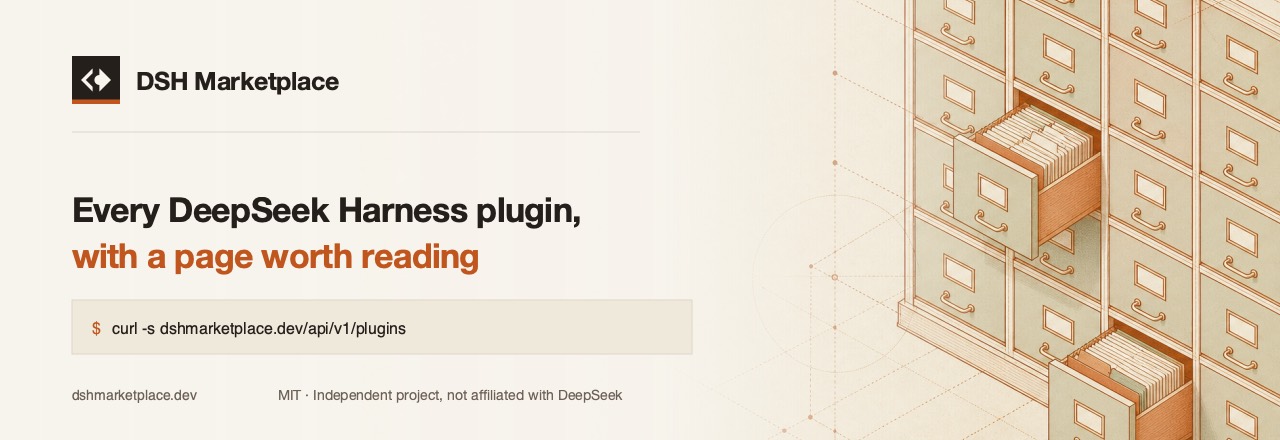
A bilingual directory of DeepSeek Harness (DSH) plugins. English at /,
Chinese at /zh, one catalogue behind both.
Live at https://dshmarketplace.dev.
DeepSeek Harness is DeepSeek's open agent harness, where every capability is a plugin. The ecosystem passed a thousand plugins within weeks of launch.
Several directories index them already. Nearly all are card walls: repository name, star count, a link straight out to GitHub. That is a table of contents, not a reference — you still have to read the source to learn what a plugin touches.
So the differentiator here is written depth. A promoted plugin gets its own page carrying an overview, a documentation section and an illustration, in both languages. That is slow to produce and cannot be scraped, which is the point.
This is deliberately early. 60 of 3,420 listings have that page today. The rest carry metadata, a verdict from a real install, and a summary while the writing catches up. Nothing is padded with generated filler to make the number look better.
| Listings | 3,420 — 3,415 not archived |
| Categories | 14, from Memory and Vision to Themes |
| Installed and checked | 2,426 — each in its own throwaway container |
| AI reviews | 2,264, bilingual |
| Chinese summaries | 1,005 hand-written; the rest are still English-only |
| Written detail pages | 60, bilingual · 57 illustrated |
| LINUX DO verified | 7 |
| Verified presets | 3 sets, installed together before publishing |
Three curated sets at /presets, each
installable with npx dshmarketplace-cli preset <id>.
A listing's verdict comes from installing that plugin into an empty profile.
A preset says its members work together, which fails in ways the parts do
not — incompatible peers, a build script blocked only once another plugin drags
in its owner, and cordis rejecting a duplicate loader entry id so a plugin
installs, reports success and is never registered. So each set is run through
the sandbox as one install of the whole list, every member has to appear in the
profile's bundles, and the date, verdict and dsh/pnpm versions of that run
are published with it. A set that quietly drops a member is worse than no set.
Building your own: add plugins from any card on the site and the bar composes a
single command. GET /api/v1/presets serves the sets as JSON.
Installed and checked is the one column no competitor can scrape: it is the
record of a run, not of a repo. Verdicts are passed 2,158,
needs-approval 194, not-a-layer 43, failed 28, timeout 1 — and only the
last two are defects. See Safety for what that does and does not
prove.
Verified means the author posted the plugin on LINUX DO under their own name and answers for it in public. It is a provenance signal, not a security review.
Every surface reads the same API, so a listing cannot say one thing in a browser and something else inside the harness.
| Web | https://dshmarketplace.dev |
| CLI | dshmarketplace-cli — for coding agents outside DSH |
| Python | dshmarketplace — zero dependencies, dshm CLI, agent tools |
| In DSH | dshmarketplace-plugin — /store inside the harness |
| In the browser | DSH Plugin Radar — a userscript that marks plugins on GitHub and npm |
No key, no registration, CORS open.
curl -s 'https://dshmarketplace.dev/api/v1/plugins?q=memory&limit=5'| Parameter | |
|---|---|
q |
Free-text search across name, summary and description |
category |
One of the 14 category ids |
limit |
1–100, default 20 |
page |
1-based |
Each result carries both summaries, the resolved install command, the risk flags and the source repository:
{
  "fullName": "Anionex/dsh-vision-toolkit",
  "summary": "…",
  "summaryZh": "…",
  "stars": 128,
  "npmPackage": "dsh-vision-toolkit",
  "install": "dsh plugin --profile web add dsh-vision-toolkit",
  "installable": true,
  "riskFlags": ["install script"],
  "repoUrl": "https://github.com/Anionex/dsh-vision-toolkit",
  "url": "https://dshmarketplace.dev/plugins/anionex-dsh-vision-toolkit"
}
install is null rather than a placeholder when no command can work. A
caller that runs whatever is in that field must never be handed something that
fails — see the note on --profile below.
curl -s 'https://dshmarketplace.dev/api/v1/index'For clients that need to know which of a thousand repositories are plugins — a browser extension decorating a GitHub topic page cannot ask one at a time. Rows are positional to keep it small, about 113 KB and 22 KB over the wire, and the column names ship with the payload:
{
  "fields": ["fullName", "category", "install", "path", "npm"],
  "plugins": [
    ["Anionex/dsh-vision-toolkit", "vision", "dsh plugin --profile web add dsh-vision-toolkit", "/plugins/anionex-dsh-vision-toolkit", "dsh-vision-toolkit"]
  ]
}
path is null when a listing has no page of its own yet, and npm is null
when the plugin publishes nowhere.
Both cost real time to find, and neither is this project's doing.
--profile is mandatory. dsh plugin forwards to pnpm inside a profile
directory, so dsh plugin add x exits with required option '--profile
<name>' not specified and installs nothing. Every command this catalogue
emits carries it.
github:owner/repo#subpath fails, but #path: works. The bare form is
read as a git ref — Could not resolve <sub> to a commit — which is why 54
monorepo plugins here still show no one-line install. That is an
understatement, not a limitation: pnpm splits the fragment on :: and treats a
path: part as a subdirectory, so github:owner/repo#path:sub installs. We
confirmed it end to end before saying so, and those listings are being fixed.
pnpm install
cp .dev.vars.example .dev.vars     # Turso credentials, at minimum
pnpm dev                           # localhost:3177
pnpm build |
Must pass before any push |
pnpm preview |
Build and run under workerd, as it deploys |
pnpm tsx scripts/sync-github.ts |
Refresh GitHub metadata |
pnpm tsx scripts/write-content.ts --limit 10 --images |
Generate detail pages |
pnpm tsx scripts/promote.ts --limit 10 |
Move pages into the sitemap |
Content generation talks to an OpenAI-shaped gateway of your choosing —
IMAGE_API_BASE and VELOKEY_* in .dev.vars. Nothing in the Worker reads
those; they are author-time only.
Push to main deploys to Cloudflare Workers in about 80 seconds.
app/(en)/            English routes — root layout sets lang="en"
app/(zh)/zh/         Chinese routes — root layout sets lang="zh-Hans"
components/views/    The pages themselves, locale-parameterised, shared by both
lib/dict.ts          Every visible string, both languages
db/schema.ts         plugins, categories, plugin_stats, submissions
scripts/             Author-time jobs: seed, sync, write, promote
Next.js 16 on Cloudflare Workers via OpenNext,
Turso for storage, Tailwind for styling. CLAUDE.md holds the engineering
rules and STATUS.md the inventory and trap list; both are worth reading
before a substantial change.
Two constraints shape more of this codebase than anything else:
marked and
sanitize-html must not reach the Worker; sync writes *Html columns.Two rules, applied to every string in lib/dict.ts:
Product and ecosystem nouns stay in English — DeepSeek Harness, DSH, topic, npm, Star, commit, agent, token, API — as do all commands, file names and config keys. Chinese developers search for these in English, and 线束 is a homophone that poisons the query.
Everything else is written the way a Chinese developer writes.
「装之前先看一眼」, not「安装前请仔细阅读」. No 让您 / 轻松 / 强大 / 赋能.
Machine translation into lib/dict.ts is not accepted.
Missing plugin, wrong category, bad summary — https://dshmarketplace.dev/submit, or open an issue. Submissions are reviewed by hand before they appear.
If you wrote the plugin and posted it on LINUX DO, include the thread and it can carry the verified badge.
Working on the code? Read CONTRIBUTING.md first. The scripts
in scripts/ write to a live catalogue that publishes install commands people
copy and verdicts under other people's names, so which ones are destructive and
what has to run before them is not guesswork. ops/README.md
says what runs where and why one CI job deliberately holds no secrets.
Plugins are third-party code running with your agent's permissions. Listing here is not a security review. Risk flags — install script, terminal surface, requires credentials — are detected automatically and shown before any install command. Their absence proves nothing. The source repository is always linked; read it first.
MIT. Plugin metadata belongs to the respective repository owners under their own licenses.
Independent project, not affiliated with DeepSeek. DeepSeek and DeepSeek Harness are marks of their respective owners, used here only to describe what these plugins are for.
CLASSIFICATION EVIDENCE
系统优先读取 GitHub Topics,再与站内分类词典和词根规则比对。当前命中: plugin-directory。
deepseek-ai
DeepSeek Harness: Everything is a Plugin.

anywhere-labs
为 DeepSeek Harness (DSH) 插件生态打造的现代化桌面端解决方案。万物皆「插件」,桌面本身也是「插件」。

walkinglabs
Harness engineering beginner tutorial, from 0 to 1