

模型与 MCP
待识别

rea
morluto
Reverse engineer anything with agents, from app behavior down to native binaries.
PROJECT TOPICS
INSTALL REFERENCE
dsh plugin --profile web add github:DDL095/dsh-moa-native
该命令指向仓库当前默认分支;尚无绑定当前 commit 的完整验证结果。
PROJECT README
Native Mixture-of-Agents for DeepSeek Harness — generation-time fusion: reference models produce pre-run drafts in parallel every turn; the single acting model executes with full tooling.


English | 中文说明
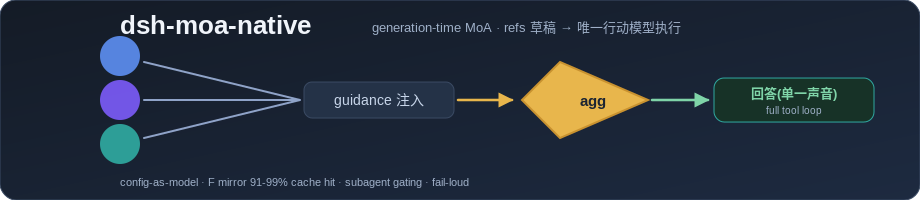
A single model has blind spots. In long sessions you want a few models reviewing the situation behind every reply — without switching tools, copy-pasting, or giving up tool use. dsh-moa-native internalizes that loop: picking one model entry runs the whole MoA pipeline for the session.
user message ──► refs consulted in parallel (private drafts, mutually unaware)
                      │
                      ▼
                guidance injected as a trailing message (never pollutes session
                history, never breaks KV prefix caching)
                      │
                      ▼
aggregator (acting model) executes with full tooling ──► replyF mirror + 3-4 heterogeneous blank-injection refs + a single aggregator + the parallel-plan discipline — one glance:
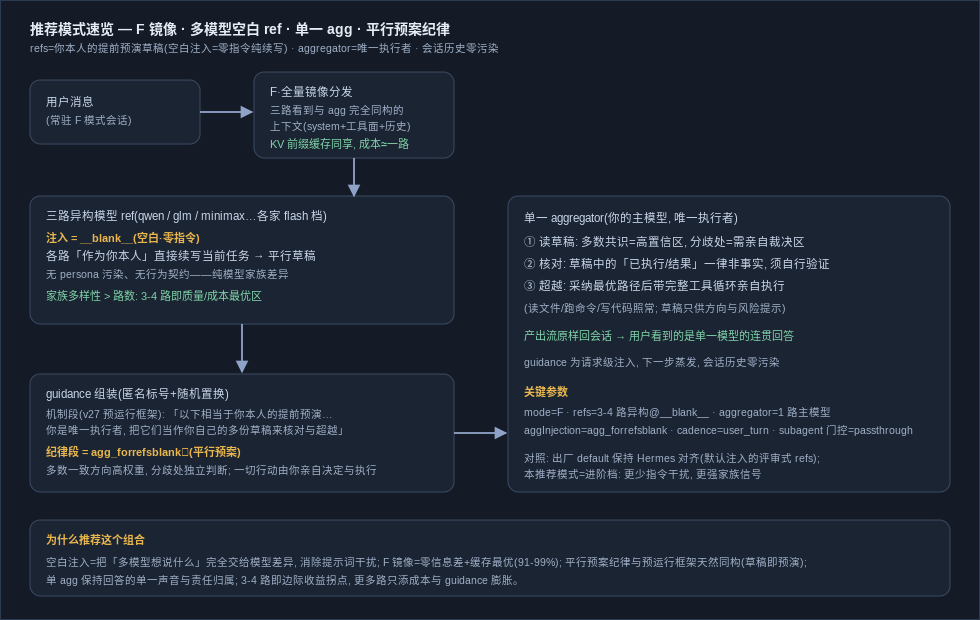
__blank__ injection (zero instruction, pure continuation — pure model-family signal, no persona noise);agg_forrefsblank (candidate action plans: where a draft agrees with your own judgement it is worth more weight, disagreements are judged independently, all actions executed by the aggregator itself);default stays Hermes-aligned (review-style refs with the default injection) — start there, switch to the recommended combo once familiar.Full part-by-part, parameter-by-parameter walkthrough: architecture.svg.
Heavy models steer every m steps, flash models patrol every n steps, and every other step reuses the last beat — free while that beat is still cached (a cache miss refills with the patrol roster).
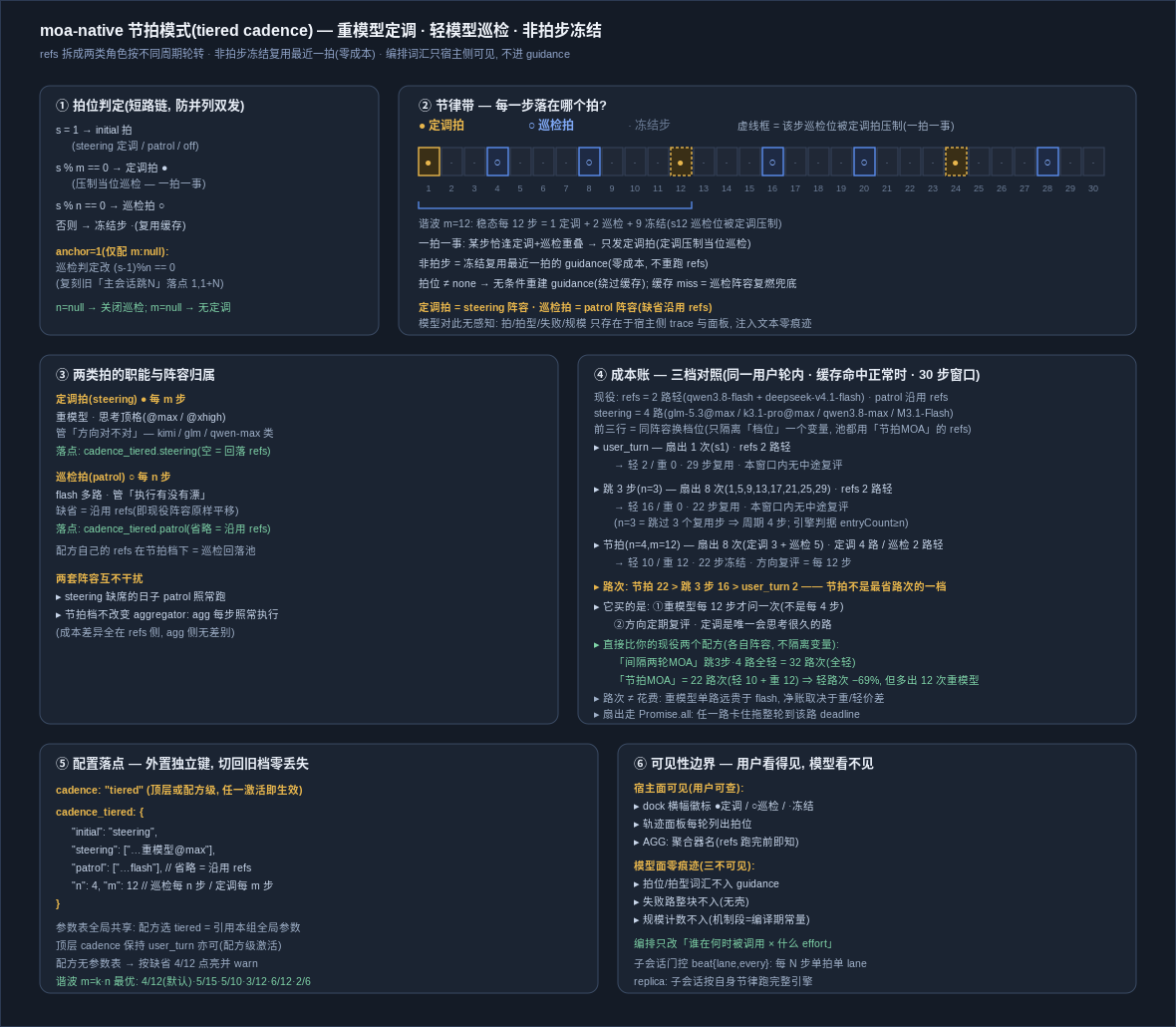
user_turn (once per user turn, cheapest), per_iteration (every step), every_n×N (skip N steps after each fan-out, so the period is N+1 steps), and tiered (the rhythm below);@max / @xhigh) whether the direction is still right — every m steps; the patrol beat asks flash refs whether the execution has drifted — every n steps;cadence_tiered.steering (the heavy models) and cadence_tiered.patrol (the flash models — omit it to keep patrol following refs); under the tiered cadence a recipe's own refs are just the patrol fallback pool;dsh plugin --profile web add dsh-moa-nativeRestart the instance and refresh the browser. The config file lives at <DSH_HOME>/profiles/<profile>/moa-native.config.json — each profile keeps its own lineup (per-profile isolation since v4.5.3; earlier releases always read the web profile's file, so a Desktop-profile panel could overwrite your web config).
default or any recipe you saved./moaR /moaF temporarily switch the reference view (lineup, aggregator, and cadence stay with the current entry; the console shows the live slash preview). Subagent sessions stream straight through the aggregator by default (zero fanout) — switch via the subagent gating dropdown (7 tiers: 3/5/8/10/15/20/30).Config as model — default and every recipe appear as model entries on the provider page; a recipe is a full preset (lineup, mode, cadence, params).
Three-level model picker (identical to the session UI) — provider → model → effort for every route.
Injection modules — each route's trailing note is a visible, editable text module: built-in default (Hermes-style), blank (zero injection), or any custom one. No hidden personas, no output-length contracts.
Two reference modes — the default is F; pick R when the input bill matters more than perfect fidelity:
(window × 0.9 − 8192) × 1.5 chars, the whole fleet flying on the minimum, so a 64k ref tightens the view and a 1M ref sees more. Tool results truncate at Hermes' own 4,000 chars (ref_tool_result_budget); ref_input_char_budget, when set, caps the dynamic budget. Unknown windows ride the conservative 128k baseline (warned once; fill contextWindow in DSH-MoA-model-registry.json to enable exact adaptation).Subagent gating — MoA applies to the main session by default; subagent sessions pass straight through the aggregator, with an optional every-N-steps upgrade. Design rationale: SUBAGENT-GATING-DESIGN.md.
Run traces — four-level drill-down: sessions (workspace-isolated) → turns → per-model cards → full advisory text. Cold-start backfill from daily zstd archives; inputs are never persisted.
Fail-loud — a failing reference route is reported as-is, never silently replaced.
Comparison with the MoA paper (arXiv:2406.04692), Hermes /moa, and community dsh-moa plugins — inheritance, superseding forms, and honest boundaries: THEORY-POSITION.md.
~/.dsh/profiles/web/moa-native.config.json (panel saves hot-reload):
{
  "refs": [                                 // direct lineup; or use named recipes
    "provider-a/model-flash@high",          // string = default injection
    { "model": "provider-b/model-x@max", "injection": "__blank__" } // object = explicit injection module
  ],
  "aggregator": "provider-c/main-model@max",
  "aggInjection": "agg_forrefsblank",       // parallel-plan discipline (recommended); default agg_default
  "mode": "F",                              // F full mirror (default, zero info gap, highest input cost) | R trimmed view (economy)
  "ref_tool_result_budget": 4000,           // R only: per-tool-result truncation budget (chars; Hermes lineage default 4000)
  "ref_input_char_budget": null,            // R only: cap on the per-model dynamic budget (unset = purely dynamic; window-derived)
  "cadence": "user_turn",                   // user_turn | per_iteration | {every_n: 2} | "tiered"(see above)
  "subagent_policy": "passthrough",         // subagent gating: passthrough | {every_n: 5} | full
  "injections": { "critic": "Your first duty is to scrutinize…" },
  "recipes": { "my-lineup": { "refs": ["..."], "aggregator": "...", "mode": "F" } },
  "prices": { "provider-a/model-flash": { "in": 0.2, "out": 0.8 } },  // optional cost estimates
  "trace": true
}| Endpoint | Description |
|---|---|
GET /moa-native/panel.json |
Config + model tables |
GET /moa-native/trace.json?limit=&ws= |
Run traces |
GET /moa-native/trace-archive.json?date=YYYYMMDD |
Daily archive read |
GET /moa-native/efforts.json?provider=&model= |
Effort tiers |
MIT
CLASSIFICATION EVIDENCE
系统优先读取 GitHub Topics,再与站内分类词典和词根规则比对。当前命中: model、models、deepseek。
morluto
Reverse engineer anything with agents, from app behavior down to native binaries.

deepseek-ai
DeepSeek Harness: Everything is a Plugin.

nexu-io
The 1st Collaborative AI Design Agent Workspace. Local-first and open source. Create motion, prototypes, websites, apps, dashboards, presentations, images, and videos with your team and AI agents. Share work, exchange feedback, and iterate together in one workspace.