
其他
完整应用

deepseek-harness
deepseek-ai
DeepSeek Harness: Everything is a Plugin.
PROJECT TOPICS
INSTALL REFERENCE
dsh plugin --profile web add github:Clearailhc/clearai-dsh
该命令指向仓库当前默认分支;尚无绑定当前 commit 的完整验证结果。
PROJECT README

English · 中文
Your research, grown into an ontology.
ClearAI is an ontology discovery and exploration platform, built on two core concepts:
Other knowledge graphs pile up edges by extraction and assertion; here every edge has to be earned through the loop.

Left: the Epistemic Loop — seven stages. Its emerald fact dot is also the first node of the domain ontology on the right. Right: the ontology graph — dark is a concept, light is a value form, emerald an instance; the instance carries two contradictory assertions — the two readings are tinted amber, marking that they do not agree. The system reports the conflict; retracting or keeping is a human decision.
A domain ontology that grows as you research:
Most agent loops track one thing: whether the task is done. The Epistemic Loop also tracks what makes a conclusion trustworthy:
| Task loop | Epistemic loop | |
|---|---|---|
| Driving question | What next? | What do we know, and on what grounds? |
| Completion | The model declares it | The system computes it from delivered evidence |
| Verdict | Whoever did it, says so | Separated — above a level, the doer cannot judge themselves |
| Failure | Deleted, retried, forgotten | Kept: a refuted hypothesis is a result, not noise |
| What accumulates | A chat transcript | An ontology: every edge earned through the loop |

Inside the ring is the instrument's read-out: the L0–L4 axis, the pre-registered threshold as a dashed line, and five observations with error bars — the supported one filled, the inconclusive drawn as a dashed circle, the refuted left in place with a slash through it (nothing is deleted). The emerald dot at the opening is the one reading that crossed the threshold and settled as a fact.
At runtime, the seven stages compress into four beats — plan, execute, observe, reflect. State is derived from the session record with no second store; the tools the model holds contain no field in which it could declare a step complete.
ClearAI does not claim recursive self-improvement. It provides the epistemic substrate a self-improving system would need. See Positioning and the OpenRSI survey.
npx clearai-dsh installThe installer's output follows your system language (--lang zh|en overrides it, doctor / seed / unseed take the same flag). Its only runtime dependency is zod; the graph stack is bundled into the client half at build time.
Restart dsh web afterwards (npx @deepseek-ai/dsh web), then create a session and switch to the ClearAI mode in the picker at the top:
dsh web and click "New session";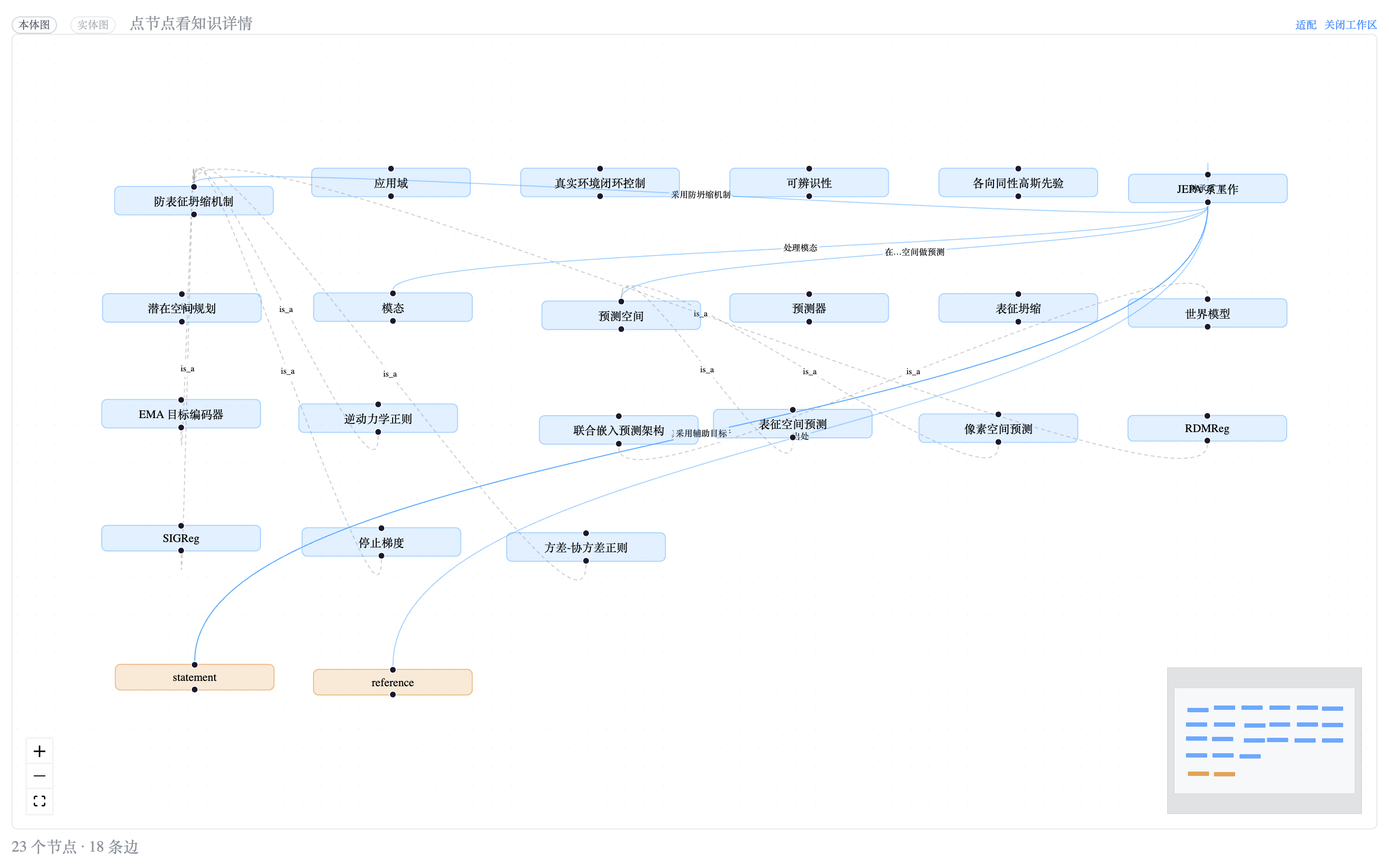
The ontology graph in ClearAI mode — this real session grew 21 concepts and 9 predicates; the same ledger always yields the same picture. (UI shown is Chinese.)
If pnpm is not on PATH: npm install -g pnpm (do not corepack enable — it installs a version forwarder that may download a pnpm it cannot launch).
From the repository:
npm test                       # 15 suites
node tools/build-package.mjs   # assemble dist/ from source
node tools/verify-package.mjs  # rebuild on the spot, byte-compare
node docs/diagrams/build-hero.mjs   # redraw the product hero (needs google-chrome)
dist/ is generated and never committed. See DSH integration.
The middle column has two switchable views: Deliverables and Ontology. The right sidebar: Worldlines and External Brain.
Ontology — this view is your knowledge home. At the top, a graph band: the ontology graph (what your domain looks like) and the entity graph (what you have actually verified) toggle with one click; clicking a node or edge opens the knowledge inspector (definition / relations / assertions / evidence chain / history), and "filter by this" is an explicit action inside the detail view. Below that, the ontology shelf: established entries, each with assertion chips (click to see what the term means), boundary, and support level; contradictions surface automatically. The vocabulary maintenance block sits collapsed at the bottom — it auto-expands when a language exists before any sentence does.
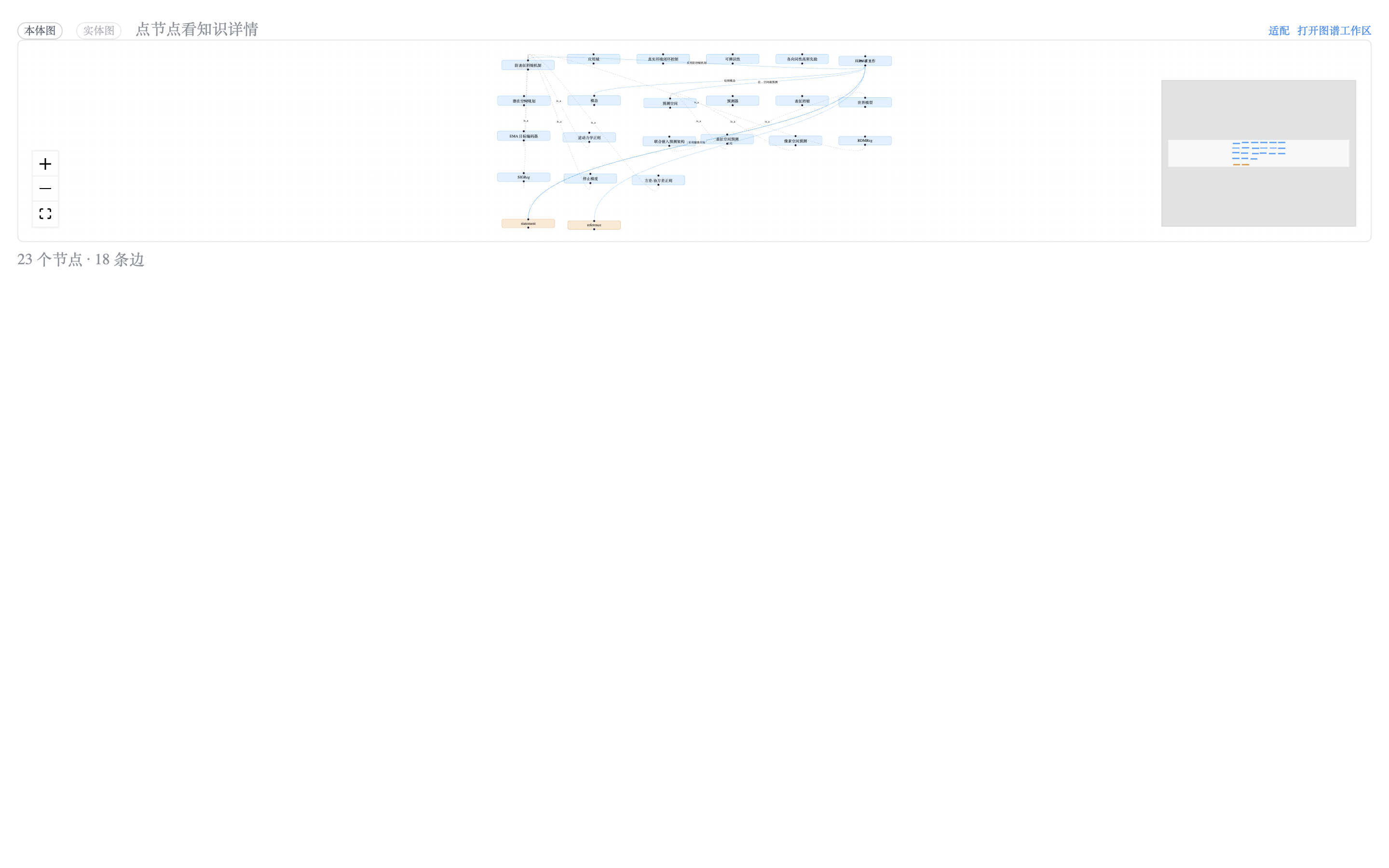
The band — the ontology graph and the entity graph share one deterministic projection, so the same ledger always yields the same picture (captured from a real session: 21 concepts, 9 predicates).
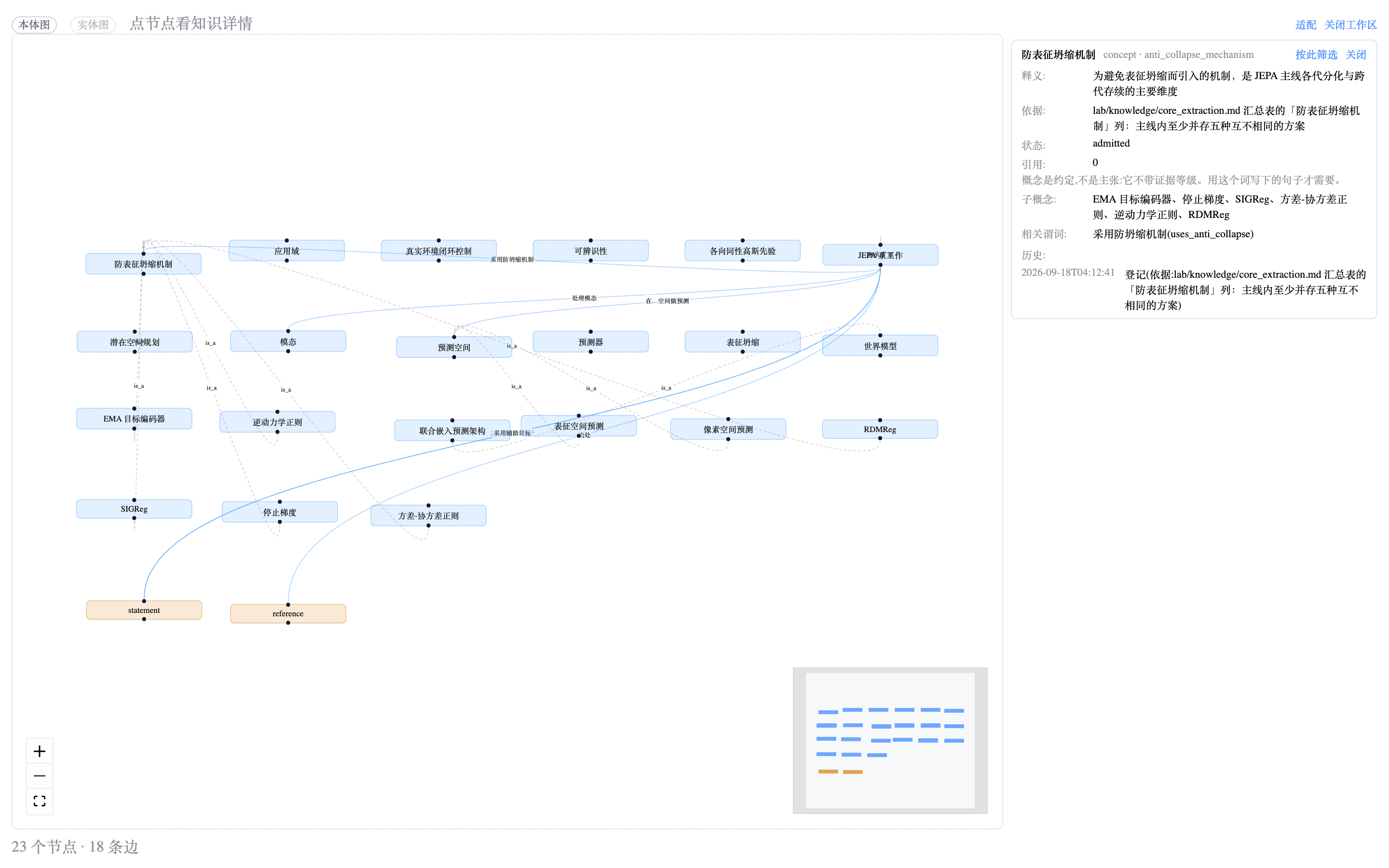
Open any node or edge: definition, relations, assertions, evidence chain, registration and revision history, all in one place. (UI shown is Chinese.)
Worldlines — when two routes genuinely disagree, they run as separate branches with their own readings; the losing one stays on record, and adoption is a human press.
Deliverables — the middle column keeps "what the plan declared" and "what actually exists on disk" apart.
External Brain — skills and memory as DSH-native entries in one merged catalogue.
ClearAI adds the epistemic layer on DSH's composition plane — one host package, one agent preset, one client module, with zero changes to the DSH engine. Working style is unrestricted, but nothing outside the governed path can write to the authoritative ledger (pinned by tests).
This project's work attribution unit is Jidian Qiyuan.
Apache-2.0, see LICENSE.
A local-first ontology discovery and exploration platform delivered as a DSH plugin. What is not yet implemented, and what has not been verified in a real browser, is written in Known gaps.
CLASSIFICATION EVIDENCE
系统优先读取 GitHub Topics,再与站内分类词典和词根规则比对。当前命中: 无有效分类标签。
deepseek-ai
DeepSeek Harness: Everything is a Plugin.

anywhere-labs
为 DeepSeek Harness (DSH) 插件生态打造的现代化桌面端解决方案。万物皆「插件」,桌面本身也是「插件」。

awesome-dsh-plugin
A curated list of plugins for DeepSeek Harness (dsh) · DeepSeek Harness 插件精选列表