
模型与 MCP
待识别

rea
morluto
Reverse engineer anything with agents, from app behavior down to native binaries.
PROJECT TOPICS
INSTALL REFERENCE
dsh plugin --profile web add github:BAIYE0303/dsh-ask-first
该命令指向仓库当前默认分支;尚无绑定当前 commit 的完整验证结果。
PROJECT README

A clarification button for the DeepSeek Harness composer — it asks what you meant before it rewrites anything.
Most prompt-rewriting plugins assume you can already say what you want, and only tidy up the wording. This one assumes the opposite: the draft is vague because the person could not say it yet. So it restates what it understood, asks two or three questions that can be answered by clicking, and only then rewrites — into a request an agent can start on without asking again.
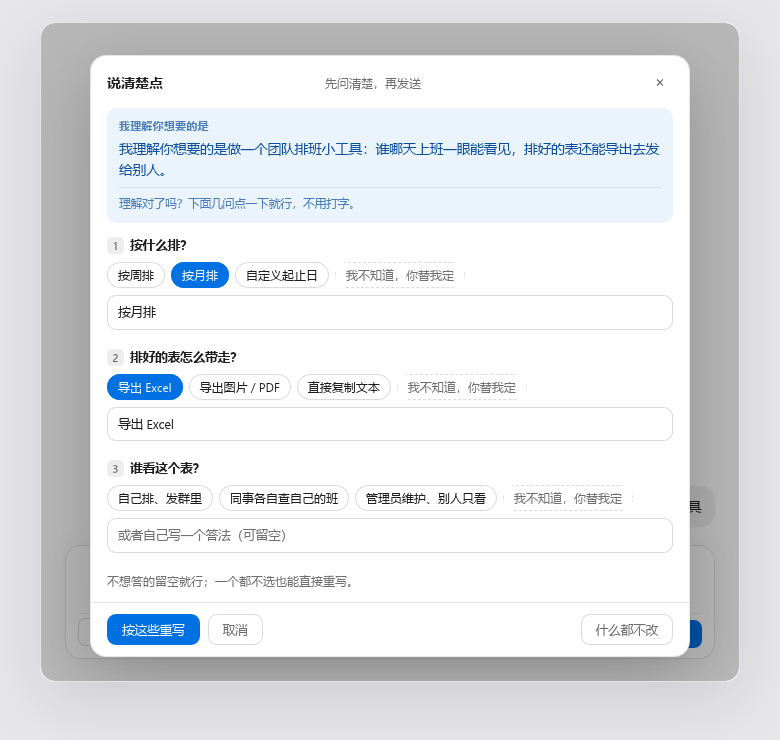
It says what it thinks you meant, asks what would actually change the answer, and hands back a request with a goal, the constraints, and a definition of done.
dsh plugin --profile web add dsh-ask-firstOr in the GUI: Plugins → Add plugin, and paste dsh-ask-first.
The plugin has a browser half, so restart the host after installing. The button then sits at the bottom-left of the composer, on the send row. There is nothing to configure and no key to paste.
Put something short in the composer — even "make me a page" — and click 说清楚点 (Say it clearer) before sending. The button's tooltip reads 不用会描述:点几下选项,我替你把需求问清楚.
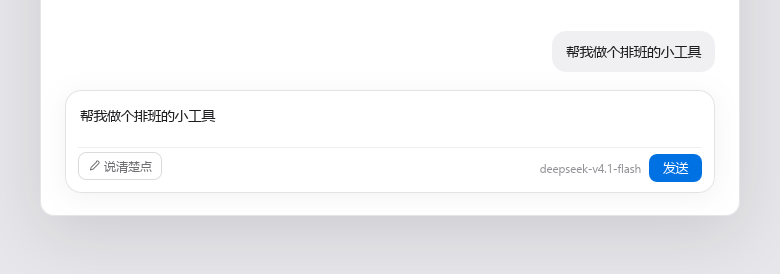
The panel opens with the title 说清楚点 and the line 先问清楚,再发送. Your draft is untouched, and nothing has been sent.
The first block in the panel is one sentence under the label 我理解你想要的是 — the model's own words for what it took from your draft. That sentence is the only thing that tells you whether it understood you, which is why it gets its own block instead of being folded into the result.
Below it: 理解对了吗?下面几问点一下就行,不用打字。 Two or three questions follow, picked because their answers would change the result. Every question comes with clickable options, and every question ends with 我不知道,你替我定 — so a user who cannot answer still has a way to answer.
Typing is optional throughout. Each question also takes a free-text line, labelled 或者自己写一个答法(可留空), and the panel says so: 不想答的留空就行;一个都不选也能直接重写。
Click 按这些重写 and you get 正在按你的选择重写……, then the result under 觉得可以就直接填回输入框;还能再改。, with a character count.
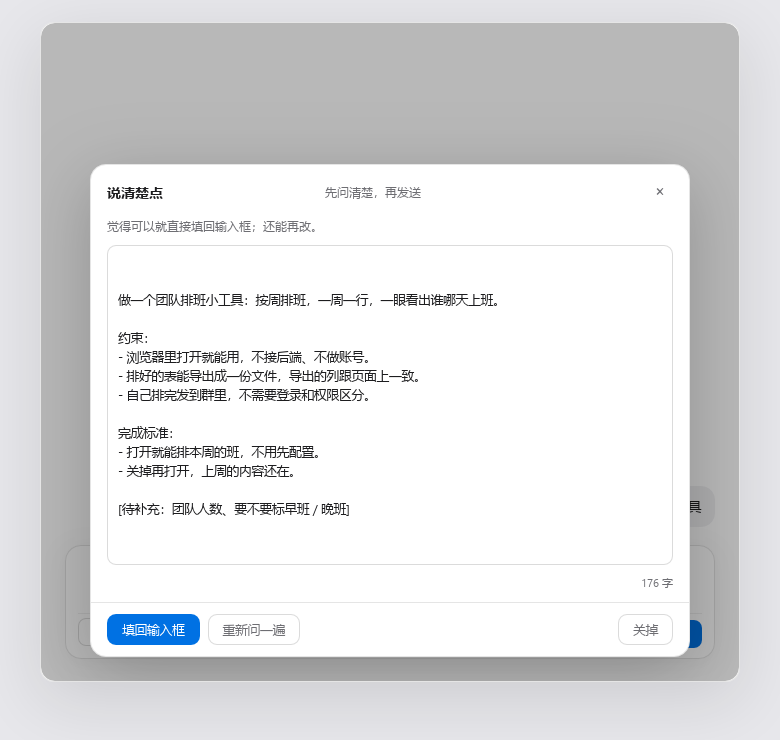
The rewrite is one request an agent can start on: goal first, then the constraints, then what counts as
done. Anything the model does not actually know stays as a visible [待补充:…] placeholder instead of
being invented. Three buttons: 填回输入框, 重新问一遍, 关掉.
It never sends. Writing the draft back is the last thing it does; the send key stays yours.
[待补充:…], to fill in or delete.inputActions.setDraft() and stops there.Two halves, one package.
| Path | Role |
|---|---|
lib/index.js |
Host half. Registers three loopback-only POST routes and makes every model call (ctx.llm.stream). |
lib/client.js |
Browser half. Registers the button and the panel in the conversation.input.left slot, and writes the result back with inputActions.setDraft(). |
cordis.patch.yml |
Lets the host insert this package into the plugin tree. |
test-offline.mjs |
Offline self-check. No network, no host: node test-offline.mjs. |
| Method | Path | Body | Response |
|---|---|---|---|
| POST | /api/dsh-ask-first/health |
{} |
{ ok, value: { llm, provider?, model? } } |
| POST | /api/dsh-ask-first/ask |
{ draft } |
{ ok, value: { guess, questions: [{ id, question, hint, options[] }] } } |
| POST | /api/dsh-ask-first/rewrite |
{ draft, answers: [{ question, answer }] } |
{ ok, value: { text } } |
All three accept loopback requests only: the socket address must be 127.0.0.1, ::1 or
::ffff:127.0.0.1, the Host header must be loopback, and a request whose Origin points at another
host — or which carries sec-fetch-site: cross-site — is refused with 403.
No API key, no provider config, no settings page. The plugin calls ctx.llm.stream with the provider and
model that agentDefaultModel.currentSelection() reports — the same one shown in the corner of the
composer. If that service is unavailable it omits both and lets the host fall back to the last target
used.
The honest cost: one click is two model calls — one to ask, one to rewrite — billed to whatever your current session is billed to.
The model is asked for strict JSON and does not always comply. If the reply cannot be parsed, that is not an error: the raw text becomes the "what I understand you want" sentence and the panel goes straight to rewriting. Questions are capped at three, options at four, and long fields are truncated, so a runaway reply cannot wreck the panel.
The rest of this file is for people checking the package, not for people deciding whether to install it.
node test-offline.mjs39 checks, no network and no host process: route registration, request validation, JSON extraction from fenced replies, option normalisation, cross-site rejection, and the request body sent to the model.
lib/client.js is a single window.__ModuleLoader__.load({ id, factory }) wrapper. That is the standard shape for a DeepSeek Harness client plugin, not a bundler artefact: the module body is plain readable source, unminified, and the only require calls are react and react-dom, which the host provides.ctx.llm service.preview/shot.html is the page the README screenshots were taken from. It loads the real lib/client.js against a stub host and a stub backend, so the shots show the actual panel. It is not part of the published package (see files in package.json), and it needs a React UMD build in preview/vendor/ to run — that directory is git-ignored, fetch it from jsDelivr if you want to regenerate shots.CLASSIFICATION EVIDENCE
系统优先读取 GitHub Topics,再与站内分类词典和词根规则比对。当前命中: deepseek-harness。
morluto
Reverse engineer anything with agents, from app behavior down to native binaries.

deepseek-ai
DeepSeek Harness: Everything is a Plugin.

nexu-io
The 1st Collaborative AI Design Agent Workspace. Local-first and open source. Create motion, prototypes, websites, apps, dashboards, presentations, images, and videos with your team and AI agents. Share work, exchange feedback, and iterate together in one workspace.