
安全与治理
插件

mirage
strukto-ai
The World's First Unified Virtual Filesystem For AI Agents
PROJECT TOPICS
INSTALL REFERENCE
dsh plugin --profile web add github:ArmyWas/dsh-failure-lens
该命令指向仓库当前默认分支;尚无绑定当前 commit 的完整验证结果。
PROJECT README


Official DeepSeek Harness community discussion
English · 简体中文说明见下文
A small, deterministic DeepSeek Harness Web client plugin (v0.2) that explains one high-confidence Windows sandbox failure the moment it appears in the conversation: spawn EPERM caused by a confined Node child process trying to use piped stdio.
It adds a single Conversation Node immediately after the matching tool result — a compact, bilingual, keyboard/assistive-technology-readable warning row. It never replaces the built-in tool row, never patches the DOM, never alters the session log, never runs another model, never auto-approves anything, and never hides raw output.
dsh-failure-lens matches only when all four of these are present in the same tool-result block:
Error: spawn EPERMcode: 'EPERM' or code: "EPERM"syscall: 'spawn' or syscall: "spawn"node:internal/child_processThe same block must also carry durable failure evidence: either isError: true or a non-zero [exit code: N] marker. Evidence is never borrowed from another block. This prevents a successful command that prints a complete historical stack from being mislabeled.
Whitespace, CRLF/LF line endings, ANSI color escapes, repeated stacks, and either quote style are handled deterministically. It does not match a generic EPERM, a user-authored assistant message, a different syscall, or a successful text that merely mentions the phrase without the structured signature and failure evidence.
This signature comes from a real exported session: tool/result, sequence 24071, whose result text carries six repeated Error: spawn EPERM stacks and ends with [exit code: 1], while its tool-result block has isError: false. Failure observers that only consume thrown tool errors never see this case; this plugin reads the already-recorded result text instead. The observed isError: false is motivation, not a matching condition—the non-zero exit marker is the durable evidence in this fixture. See Evidence boundary.
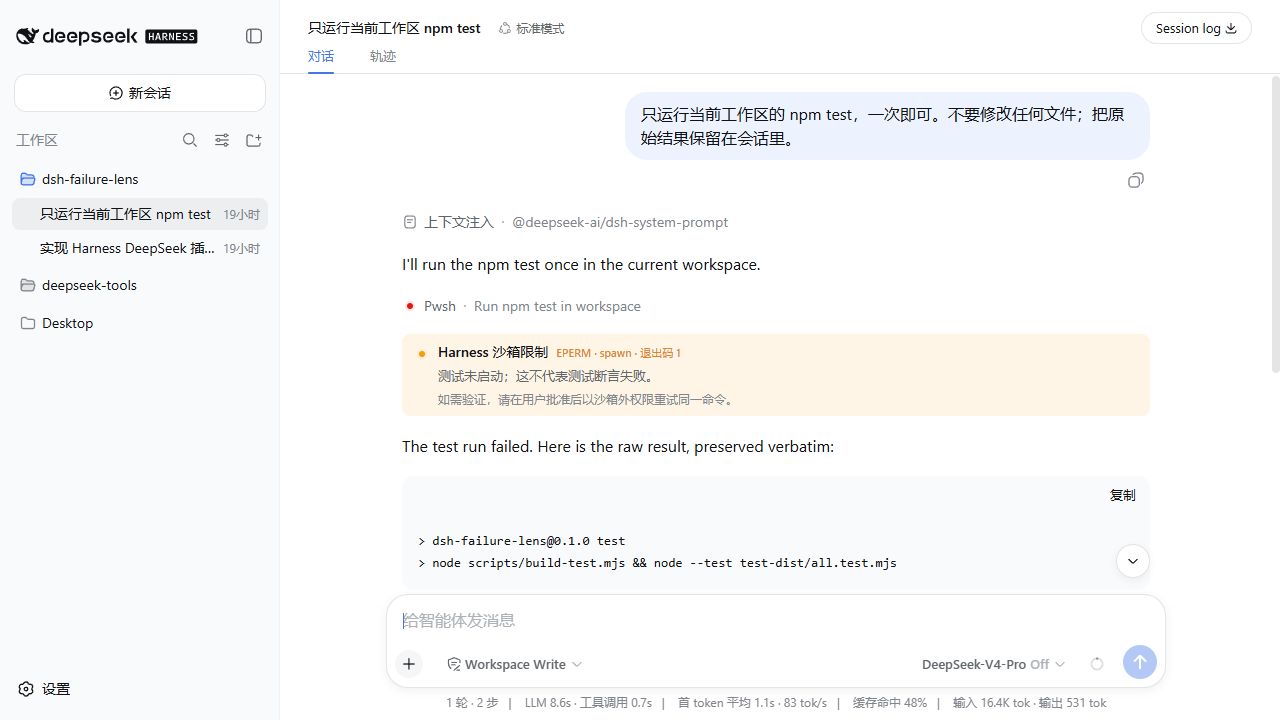
The screenshot above is the installed v0.2 plugin replaying a durable, real
npm test event inside Harness—not a mockup. The raw event was produced by the
v0.1.0 workspace test; v0.2 reclassifies that unchanged session evidence after
a clean service restart and adds the parsed exit 1 chip.
After a matching tool result, a compact warning row appears using the official Harness visual language and design tokens (StateDot, row chrome, --dsw-alias-* tokens):
| Chinese | English |
|---|---|
| Harness 沙箱限制 | Harness sandbox limitation |
| 测试未启动;这不代表测试断言失败。 | The test never started; this does not mean a test assertion failed. |
| 如需验证,请在用户批准后以沙箱外权限重试同一命令。 | To verify, retry the same command outside the sandbox after user approval. |
EPERM · spawn · 退出码 1 |
EPERM · spawn · exit 1 |
The row is historical information: it reads what already happened and never invents facts. Raw output remains in the built-in tool card immediately above it.
This plugin is deliberately narrow and is not
dsh-fail-logger:
dsh-fail-logger records thrown failures into a long-term skill and explicitly does not trigger for non-zero shell exit codes. This observed event is isError: false and a non-zero exit code, so it falls outside that tool's contract.dsh-failure-lens adds no record, writes no skill, and triggers only on the four-condition spawn EPERM signature plus same-block failure evidence. It is a read-only, presentational explanation of one known sandbox boundary.Requires Node ^22.19.0 || >=24.0.0 and a DeepSeek Harness Web profile.
Install the prebuilt GitHub release (no clone or local build required):
dsh plugin --profile web add https://github.com/ArmyWas/dsh-failure-lens/releases/download/v0.2.0/dsh-failure-lens-0.2.0.tgzOr install a local checkout while developing:
dsh plugin --profile web add link:<path-to-dsh-failure-lens>The package declares its shipped cordis.patch.yml through dsh.bundle.patch.
The dsh plugin command installs the dependency and appends the bundle to the
profile's ordered dsh.profile.bundles list. Restart the Web profile and
refresh the browser.
dsh plugin --profile web remove dsh-failure-lensThe same dsh plugin command removes the dependency and its bundle-list entry.
To roll back to a prior composition without uninstalling, edit the profile's cordis.patch.yml (under $DSH_HOME/profiles/web) to disable the plugin row:
- id: dsh-failure-lens
  disabled: true
Rollback is immediate: the plugin owns no durable state, writes nothing to the session log, and its disposer removes the Conversation Definition, keyed renderer, and locale dictionaries exactly as the official client plugin lifecycle requires.
conversationEvents.register, slots.inject('conversation.chat.node', …), and locale.register surfaces. There is no DOM injection and no import of private client internals.The signature-plus-failure-evidence conjunction is deliberately conservative. A false positive is still possible if a non-sandboxed process fails with an identically-shaped Node spawn EPERM stack and a non-zero exit/tool-error flag. The row therefore says what this evidence is consistent with and preserves the raw result above it; please file an issue with a privacy-trimmed event if you see a row you believe is wrong.
See CONTRIBUTING.md, SECURITY.md, and Evidence boundary. The test suite includes a positive case derived from a real exported Harness session and negative lookalikes (generic EPERM, different syscall, user-authored text, missing structure, successful historical output, cross-block evidence, ANSI/CRLF/repeated stacks). Run npm test, npm run typecheck, npm run build, and npm run pack:check before opening a PR.
Apache-2.0. See LICENSE.
dsh-failure-lens 是一个确定性的 DeepSeek Harness 网页客户端插件(v0.2)。它只在同一个 tool-result 块中同时出现以下四项签名证据时才提示,并紧跟在匹配的工具结果之后插入一个独立的 Conversation Node(紧凑警告行,中英双语,支持键盘与屏幕阅读器):
Error: spawn EPERMcode: 'EPERM' 或 code: "EPERM"syscall: 'spawn' 或 syscall: "spawn"node:internal/child_process)同一块还必须有可持久验证的失败证据:isError: true,或非零 [exit code: N];插件不会跨块拼接签名或借用失败标记。因此,成功命令即使打印了一段完整的历史错误栈也不会误触发。
它不会替换官方工具行、不会做 DOM 注入、不会修改会话日志、不会调用模型、不会自动审批,也不会复制原始长日志。该签名来自真实导出的会话(tool/result,序列 24071,六个重复 Error: spawn EPERM 栈并以 [exit code: 1] 结尾)。其中 isError: false 是我们发现观察盲区的动机,不是分类条件;本事件由非零退出码提供失败证据。详见证据边界。
它与 dsh-fail-logger 的边界:后者只记录被抛出的失败,且不处理非零退出码;而本事件是 isError: false 的非零退出码,本插件只做只读、展示性的解释,不写入任何长期记忆。
安装已构建版本:dsh plugin --profile web add https://github.com/ArmyWas/dsh-failure-lens/releases/download/v0.2.0/dsh-failure-lens-0.2.0.tgz;本地开发可用 dsh plugin --profile web add link:<路径>。该命令会安装依赖,并把 bundle 自动追加到 profile 的 dsh.profile.bundles,随后重启 Web profile。卸载:dsh plugin --profile web remove dsh-failure-lens,它会同步移除 bundle 条目。插件不产生任何持久状态。
隐私与安全:无遥测、无网络、无磁盘写入、无模型调用、无自动审批、无原始输出复制、无 DOM 补丁,全部通过官方 conversationEvents.register / slots.inject / locale.register 三个公开接口组合。
CLASSIFICATION EVIDENCE
系统优先读取 GitHub Topics,再与站内分类词典和词根规则比对。当前命中: developer-tools、sandbox。
strukto-ai
The World's First Unified Virtual Filesystem For AI Agents

toby-bridges
Local security audit for AI API relays and LLM proxies: detects prompt injection, model substitution, tool-call rewriting, SSE anomalies, error leakage, and Web3 wallet risks.

xiaods
k8e.sh - OpenSource Agentic AI Sandbox Matrix