




Agent 与会话
插件

nuwa-skill
alchaincyf
你想蒸馏的下一个员工,何必是同事。蒸馏任何人的思维方式——心智模型、决策启发式、表达DNA。Distill how anyone thinks.
PROJECT TOPICS
INSTALL REFERENCE
dsh plugin --profile web add github:Anthony-Vivalink/foreman-plane
该命令指向仓库当前默认分支;尚无绑定当前 commit 的完整验证结果。
PROJECT README
foreman-plane is a governance plane that runs outside the agent harness. DeepSeek Harness, Claude Code, Codex and any CLI agent are interchangeable execution bodies. What the plane owns is the part a session cannot own: dispatch, dependency gating, objective acceptance and an append-only ledger.
A promise the agent forgot is not a promise. The verdict is derived from files on disk, so it outlives the session that produced it.
It is sized for one person, one machine, one state directory — a personal tool, not an enterprise platform. See Scope.
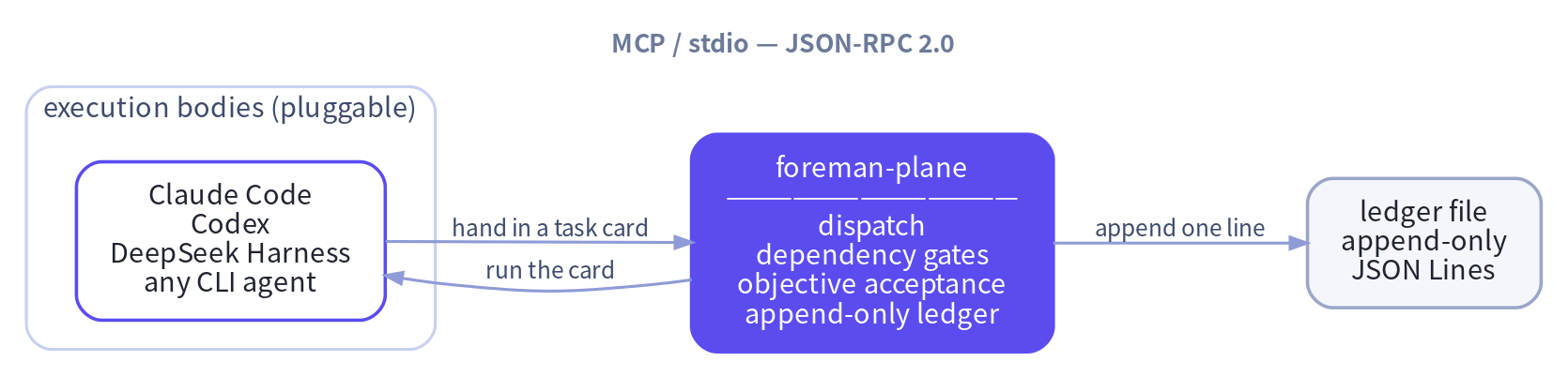
┌──────────────────┐        ┌──────────────────────┐
│ execution bodies │        │ foreman-plane        │
│ Claude Code      │ ─────▶ │ dispatch             │
│ Codex            │        │ dependency gates     │
│ DeepSeek Harness │ ◀───── │ objective acceptance │
│ any CLI agent    │        │ append-only ledger   │
└──────────────────┘        └──────────────────────┘
MCP / stdio — JSON-RPC 2.0, one JSON object per lineZero third-party dependencies. Python ≥ 3.10, standard library only.
| Capability | What it changes |
|---|---|
| Two-level dependency gate | A card with [depends_on] cannot start until every upstream is terminal, passed and accepted. [needs_api] is the soft level: a missing artefact is reported, the task still runs. |
| Objective acceptance | Pass and fail are computed from the artefact — min_bytes, sha256, contains, exit_code. A task that promises a report but writes no file fails. |
| No ghost dispatch | A card stopped by the gate writes a blocked event and no dispatch event, so the ledger can never show a task that never ran. |
| Append-only ledger | One JSON line per decision. History is never rewritten or deleted, and it can be queried, diffed and audited by something that is not an LLM. |
| Pluggable execution bodies | The plane picks no model and does not care which command runs a card. Swap the command, keep the governance. |
| Unparsed dependencies are fatal | A dependency marker that cannot be parsed refuses the dispatch. It is never silently dropped. |
A personal tool, not an enterprise platform. foreman-plane is deliberately small. It is designed for one person, one machine, one state directory — not for a team, a fleet or a regulated org. Saying this out loud is part of the design: a tool that pretends to be a platform costs you more in configuration than it saves.
What it is
FOREMAN_HOME) and one append-only JSONL ledger.cat and jq — no service account, no proprietary store.What it is not, and is not going to grow into
| Not this | Why — and what to use instead |
|---|---|
| A multi-tenant platform | No tenancy, no RBAC, no SSO, no audit export. One FOREMAN_HOME belongs to one person. |
| A durable workflow engine | No daemon, no queue broker, no timers, no HA, no retries at scale. For resumable long-running workflows use Temporal, Airflow or Argo Workflows. |
| A database | The ledger is a JSONL file — fast and auditable at the scale of one person's tasks, not a sharded store with a query planner. |
| An enterprise audit product | No retention policy engine, no signed reports, no compliance controls. |
| A place for business logic | The plane decides nothing. Your agent owns the work; the plane owns the sequence, the gate and the verdict. |
| A dashboard | The whole surface is CLI, MCP stdio and a Python API. There is no UI and no web server. |
Why this is a feature
The tool fits in one directory, starts in milliseconds, and can be read end to end with a text editor. If your requirement is "our forty-person org needs approval workflows with SLA clocks and a Postgres-backed audit trail", this is the wrong tool and you should not spend an afternoon on it. If it is "my agents keep forgetting what they promised last week and I want a ledger that says so", it is exactly the right size.
Where it stops and something else starts
| If you need | Use |
|---|---|
| Durability across days, HA, thousands of concurrent tasks | Temporal / Airflow / Argo Workflows |
| A team-wide approval and audit product | Jira / ServiceNow / a workflow platform with a real admin model |
| Human task tracking and reporting | Beads, or a plain issue tracker |
| A single-machine, dependency-aware, model-free task ledger for your own agents | foreman-plane |
Two code lines, one contract. This package and the shell-based control plane it grew out of share the ledger format, the task-card contract and the acceptance-criteria syntax — but not the execution body. The table above says where the plane stops; DIVERGENCE.md records what the two lines share, what stays local, and the rule for deciding when a fix has to be released back into the package.
You:
Finish these reports first, then let the downstream job merge them.foreman-plane: Three cards. The downstream one carries
[depends_on], so it cannot even start while the upstream files are missing. When everything is done the artefacts get checked again, a missing field meansfail, and the ledger records which file fell short.
pip install foreman-planeYou get two identical commands — use whichever you like:
foreman-plane --help   # canonical
gongtou --help          # short alias (工头)
There is deliberately no foreman command. That name is already taken by
other projects — an AI orchestration engine on npm, an infrastructure manager
on GitHub — and two packages shipping the same binary name is a real conflict
on PATH. The Python package is foreman_plane, so it does not collide with
the unrelated foreman library on PyPI either.
Or run it straight from a checkout:
cd foreman-plane
export PYTHONPATH="$PWD/src"
export FOREMAN_HOME="$PWD/.foreman"
Ready to run it? Deployment below is the step-by-step: where the plane keeps its state, which command executes a card, the first card you hand in, and how to wire it into your harness.
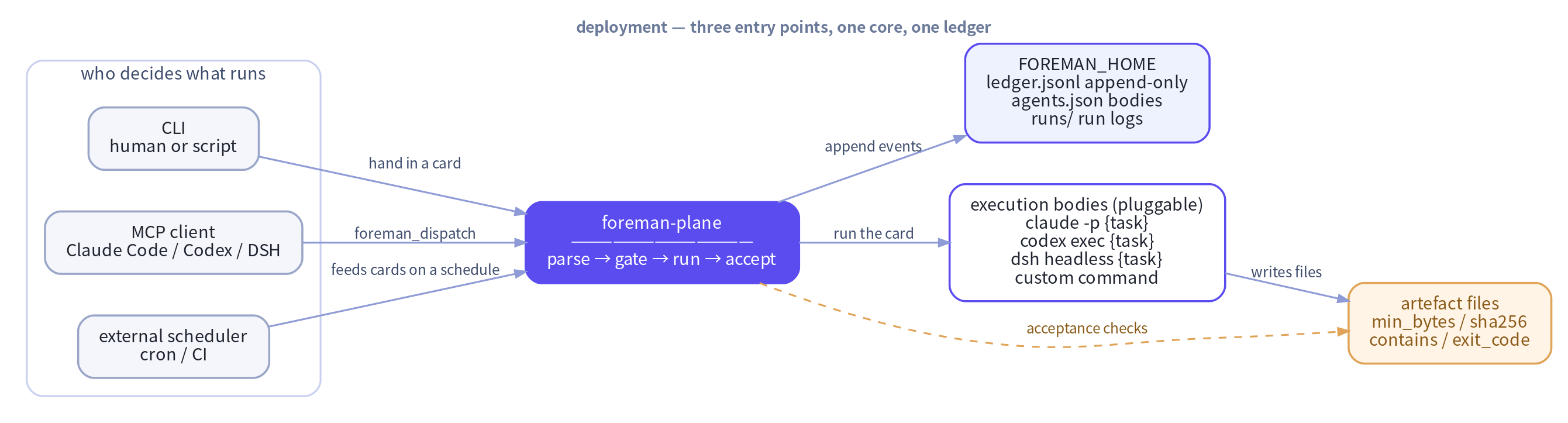
foreman-plane is a plain process, not a service. There is no daemon, no port, no database and no scheduler. "Deploying" it is three decisions, not a deployment guide:
| Decision | Where | Default |
|---|---|---|
| Where the plane keeps its state | FOREMAN_HOME |
$HOME/.foreman |
| Which command executes a card | ${FOREMAN_HOME}/agents.json |
the built-in generic — empty, so it fails until you define it |
| Who may hand in cards | the caller: a person, a script or an MCP client | — |
pip install foreman-plane
foreman-plane --help
foreman-plane config
foreman-plane and gongtou are the same program. The module entry points are
python -m foreman_plane.cli and python -m foreman_plane.mcp_server.
foreman-plane config prints the effective home, the ledger path, the run directory
and the known execution bodies. Nothing is written yet.
export FOREMAN_HOME=/var/lib/foreman
foreman-plane config
Everything the plane owns lives under FOREMAN_HOME:
| Path | Written by | Purpose |
|---|---|---|
ledger.jsonl |
the plane | the append-only audit ledger — the source of truth |
runs/ |
the plane | one log file per run: stdout, stderr, exit code |
agents.json |
you | the execution bodies |
FOREMAN_HOME resolves as: the environment variable → $HOME/.foreman →
<cwd>/.foreman. It works even when HOME is not set. The home and runs/
are created automatically; agents.json is only read, never written for you.
cat > /var/lib/foreman/agents.json <<'JSON'
{
  "agents": {
    "dsh":    {"command": "dsh headless {task}"},
    "claude": {"command": "claude -p {task}"},
    "codex":  {"command": "codex exec {task}"},
    "mybot":  {"command": "mybot run --prompt {task}"}
  }
}
JSON
Two placeholders are available: {task} — replaced with the whole task card —
and {workdir} — replaced with the working directory. A template without
{task} is refused: the plane will not guess what the agent should be
told, so the run ends with exit_code: 127 before anything starts.
The command is executed as a subprocess — no shell, so there is no quoting to
get wrong — in the working directory you pass to dispatch, under a
wall-clock limit of FOREMAN_TIMEOUT seconds (default 900).
The names claude, codex, dsh and generic already exist; your
agents.json overrides or extends them. generic has an empty command, so a
card dispatched to it ends with exit_code: 127 — the plane never guesses an
agent for you.
Every card needs an [id]; a card without one is refused
(task_id_missing).
cat > /tmp/card.md <<'MD'
[id] T-20261109-01
[acceptance] reports/report.md::min_bytes=200::contains=Conclusion

Read the notes and write a summary. End it with a "Conclusion" section.
MD

foreman-plane dispatch --file /tmp/card.md --agent dsh --workdir /srv/work
The command runs the card to completion and then reports the verdict:
task_id: T-20261109-01
ok: true
verdict: pass
acceptance_ok: true
exit_code: 0
--json prints the whole receipt instead. Exit codes: 0 success, 2 blocked
by the gate, 3 artefact acceptance failed, 1 anything else.
This is the usual deployment: an agent decides what to run, the plane guarantees when and whether. The agent talks MCP over stdio — one JSON object per line, no port, no daemon to keep alive.
DeepSeek Harness — no plugin code, just point the profile at the server:
# ~/.dsh/profiles/headless/cordis.patch.yml
mcp:
  servers:
    - name: foreman
      command: python3
      args:
        - -m
        - foreman_plane.mcp_server
      env:
        FOREMAN_HOME: /var/lib/foreman
Claude Code, Codex or any MCP client:
{
  "mcpServers": {
    "foreman": {
      "command": "python3",
      "args": ["-m", "foreman_plane.mcp_server"],
      "env": { "FOREMAN_HOME": "/var/lib/foreman" }
    }
  }
}
The orchestrator gets three tools: foreman_dispatch, foreman_status,
foreman_cancel.
The plane never decides. It has no planner, no model, no priority queue and no scheduler. It executes the cards it is handed and refuses the ones whose hard dependencies are not met yet.
decides → writes a card → hands it in (CLI / MCP) → plane gates, runs, acceptsA blocked card is not woken up automatically: once the upstream passes,
the orchestrator (or you) submits the card again. blocked is deliberately
not dispatched, so a blocked task stays re-dispatchable — otherwise the task
graph would deadlock and the upstream could never unblock it.
| Variable | Default | Meaning |
|---|---|---|
FOREMAN_HOME |
$HOME/.foreman |
plane home: ledger, run logs, agents.json |
FOREMAN_TIMEOUT |
900 |
execution timeout in seconds |
FOREMAN_AGENT |
generic |
default execution body |
FOREMAN_ACTOR |
foreman |
actor recorded in the ledger |
For where this stops being the right tool, see Scope.
| Symptom | What it means | Fix |
|---|---|---|
exit 2, dependency_pending |
the upstream has not finished yet | wait for it, then submit the card again |
exit 2, dependency_unaccepted |
the upstream ran but its artefact failed | fix the upstream, then re-submit |
exit 2, dependency_unknown |
that upstream id was never dispatched | check the id |
exit 2, dependency_unparsed |
the [depends_on] marker could not be parsed |
fix the card — the plane refuses to guess |
exit 2, dependency_cycle |
the dependency graph loops | break the cycle |
exit 2, duplicate_task |
that id already has a dispatch event |
a new id, --force, or foreman-plane ledger replan |
exit 2, task_id_missing |
the card has no [id] |
add one |
| exit 3 | the artefact is missing, too small or missing the marker | read the run log in runs/ |
exit_code: 127, no such agent, or its command template is empty |
the agent name is not in agents.json |
add the agent, or use one of the built-ins |
exit_code: 127, command template has no {task} placeholder |
the template forgot the placeholder | add {task} |
exit_code: 127, executable is not on PATH |
the command cannot be found | fix agents.json or PATH |
The CLI exit code and the agent's exit code are different things: exit 2
and exit 3 are the CLI's, while exit_code: in the receipt is the
execution body's. Every failed run — including the ones that never started —
leaves a log under ${FOREMAN_HOME}/runs/, and the receipt carries the tail
of stderr.
A task card is plain text. Four markers may appear anywhere in it:
| Marker | Meaning |
|---|---|
[id] |
task id, shaped like T-YYYYMMDD-NN |
[depends_on] |
hard dependency: the upstream must be terminal, passed and accepted |
[needs_api] |
soft dependency: the artefact only has to exist, not be finished |
[acceptance] |
acceptance artefact plus optional objective criteria |
[id] T-20261109-20
[depends_on] T-20261109-01
[needs_api] T-20261109-01#/var/lib/foreman/api/order_book.json
[acceptance] reports/order_book_20261109.md::min_bytes=200::contains=Conclusion

Read order_book.json, produce the report and add a Conclusion section.
The half-width bracketed form above is the canonical one. The full-width
variants such as 【id】 and the colon forms such as id: are still accepted,
as are full-width spaces and colons. What never happens is a silent drop —
a dependency marker that cannot be parsed refuses the dispatch with
dependency_unparsed.
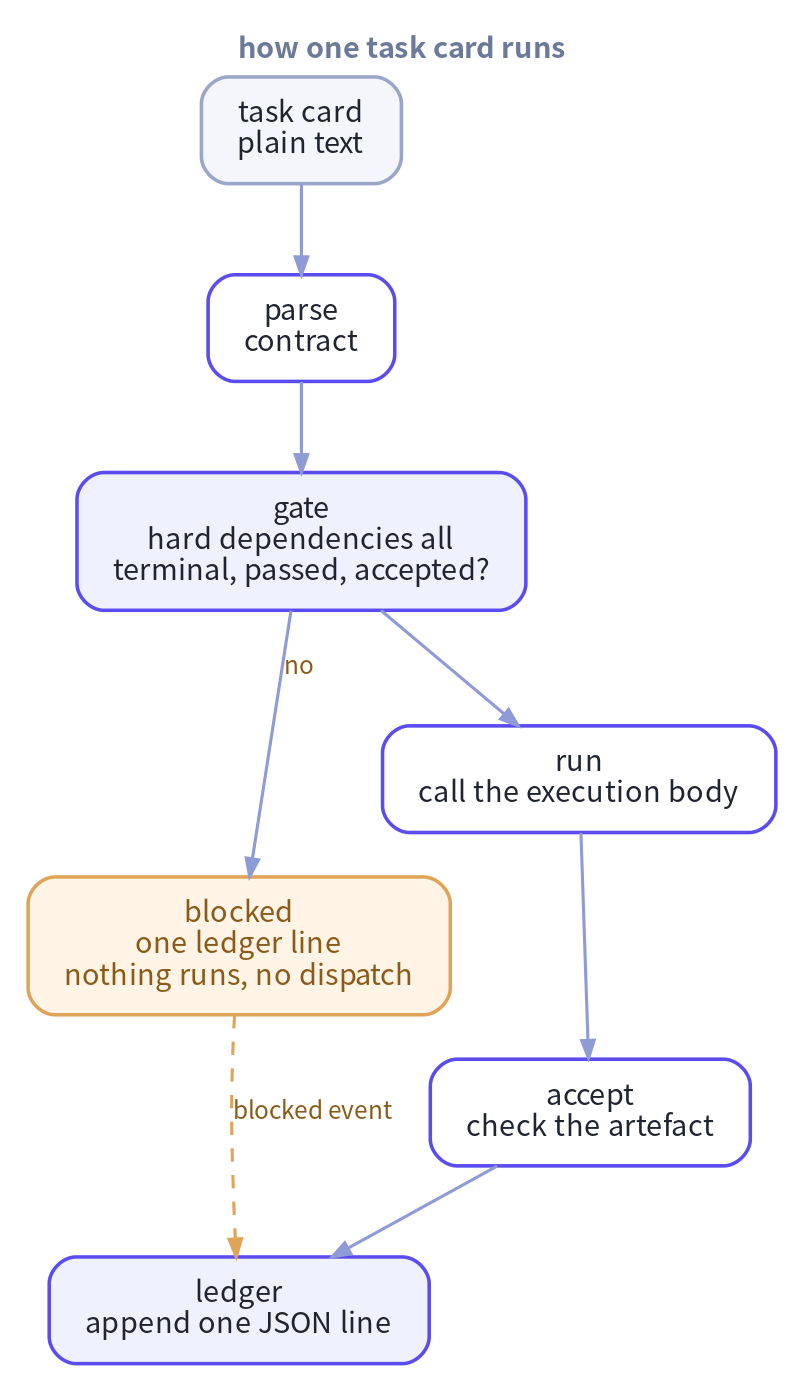
  task card
    │
    ├─ parse ──▶ contract: id / hard dependencies / soft dependencies / acceptance criteria
    │
    ├─ gate ───▶ every hard dependency terminal, passed and accepted?
    │              ├─ no  ──▶ blocked: one ledger line, nothing runs, no dispatch event
    │              └─ yes
    │                   ▼
    ├─ run ────▶ call the execution body: Claude Code / Codex / DSH / any command
    │
    ├─ accept ─▶ check the artefact: min_bytes / sha256 / contains / exit_code
    │
└─ ledger ─▶ append one JSON line: dispatch / running / done / blocked / …A card with [depends_on] is released only when every upstream task is
terminal, verdict=pass and artefact acceptance passed. Otherwise the plane
writes a blocked event and stops. There is no dispatch event for a task
that did not run, so the ledger cannot show a ghost dispatch.
[depends_on] T-20261109-01  →  upstream done, verdict=pass   →  released
                             →  upstream still running        →  blocked(dependency_pending)
                             →  upstream unknown               →  blocked(dependency_unknown)
                             →  upstream verdict=fail          →  blocked(dependency_failed)
→ unparsable dependency marker → blocked(dependency_unparsed)[needs_api] marks artefacts that must be ready but do not have to be
finished. A missing artefact is reported as needs_api_pending and the task
still runs.
[acceptance] reports/report.md::min_bytes=200::sha256=<hex>::contains=ConclusionSupported criteria: min_bytes, sha256, contains, exit_code. All
criteria are ANDed, relative paths resolve against the working directory, and
an unknown criterion fails closed.
Every decision is one JSON line in ${FOREMAN_HOME}/ledger.jsonl:
{"ts":"2026-11-09T09:41:02.113456+00:00","event":"dispatch","task_id":"T-20261109-20","actor":"foreman","depends_on":["T-20261109-01"],"needs_api":[],"acceptance":"reports/report.md::min_bytes=200","needs_api_pending":false,"detail":{}}Event types: dispatch, running, blocked, done, cancelled, replan.
History is never rewritten or deleted.
| Tool | Purpose |
|---|---|
foreman_dispatch |
dispatch a task card: parse, gate, run, accept |
foreman_status |
ledger status of one task or of everything |
foreman_cancel |
cancel a task; unknown ids are rejected |
The tool names keep their foreman_ prefix: they are a namespace inside MCP,
not a binary name, so the CLI rename does not touch them.
foreman-plane dispatch --file TASK.md [--agent NAME] [--workdir DIR] [--force] [--json]
foreman-plane status   [--task-id ID] [--json]
foreman-plane ledger   list | show | ready | blocked | cancel | replan
foreman-plane verify   --acceptance "<acceptance string>"
foreman-plane mcp
foreman-plane config
Exit codes: 0 success, 2 blocked by the gate, 3 artefact acceptance failed,
1 anything else.
PYTHONPATH=src python3 -m unittest discover -s tests -vThe specification lives in docs/SPEC.md, the wire contract in
docs/PROTOCOL.md.
MIT — see LICENSE.
CLASSIFICATION EVIDENCE
系统优先读取 GitHub Topics,再与站内分类词典和词根规则比对。当前命中: agent。
alchaincyf
你想蒸馏的下一个员工,何必是同事。蒸馏任何人的思维方式——心智模型、决策启发式、表达DNA。Distill how anyone thinks.

freestylefly
Prompt as Code | GPT Image 2 / 2.5 提示词与案例库,530+ 个案例、20+ 套工业级模板与可复用 Skills,新增 2.5 同提示词对比专区,附完整提示词与生成记录,持续更新。

titanwings
Distilly — Distill how they think into reusable Skills for any Agent or Bot. Formerly Colleague Skill(原同事 Skill).