
模型与 MCP
待识别

rea
morluto
Reverse engineer anything with agents, from app behavior down to native binaries.
PROJECT TOPICS
INSTALL REFERENCE
dsh plugin --profile web add github:Anguis-L/dsh-plugin-adoption
该命令指向仓库当前默认分支;尚无绑定当前 commit 的完整验证结果。
PROJECT README
# dsh-plugin-adoption
Rank DSH plugins by real monthly npm downloads instead of GitHub stars. It carries two further independent dimensions: capability-surface risk (C0鈥揅3) and version line (will it even install?).


涓枃璇存槑瑙?README.zh.md銆?
What it does and does not do
This plugin reads public sources and ranks what it finds. It does not write, install, modify or rate-limit anything.
| Reads | the 1024Store catalog API (public, read-only), npm's official downloads endpoint (public, read-only), and the dsh-xray capability snapshot (public, read-only) |
| Writes | nothing 鈥?no file, no config, no registry state, no other plugin |
| Network | GET only, to the public APIs, the npm registry and dsh-xray |
| Registers | one tool, plugin_adoption. No HTTP route of its own |
| Modifies other plugins | never. It reports a ranking; it does not enforce one |
The two numbers it compares measure different things and the report says so every time: stars measure the attention a repository received, downloads measure installs that actually happened. Neither is a quality score, and this plugin does not produce one 鈥?it reports the disagreement between the two orderings and leaves the judgement to the caller.
Two things it deliberately does not do: it does not count plugins without an
npm package as zero (they are listed separately, under noPackage), and it
does not hide a failed request behind an empty result (they appear in
requestFailures, with the count of candidates that were actually compared).
The same rule governs the capability dimension: an ungraded plugin is reported
as unknown, never as C0.
The catalog API allows 50 anonymous requests a day, so a default run samples a bounded number of candidates rather than the whole catalog.
Recommended 鈥?a prebuilt tarball, so there is no build step and no npm publish in the way:
dsh plugin --profile <your-profile> add \
  https://github.com/Anguis-L/dsh-plugin-adoption/releases/download/v0.2.0/dsh-plugin-adoption-0.2.0.tgz
Verified end to end on a real DSH host: the command above installs in ~4s, and
dsh --profile <profile> --dump-config then shows the bundle layer:
# == dsh-plugin-adoption
- id: plugin-adoption
  name: dsh-plugin-adoption
Installing from the repository also works, and that form is the one 1024Store's install analytics counts:
dsh plugin --profile <your-profile> add github:Anguis-L/dsh-plugin-adoptiondsh plugin --profile <your-profile> add dsh-plugin-adoptionVersion v0.2.0. Restart dsh once after installing (the bundle layer is
assembled at startup), then ask the agent to call plugin_adoption.
Community discovery surfaces order by GitHub stars. But a star measures the attention a repository got, not an install that happened. Measured against the live catalog on 2026-10-25:
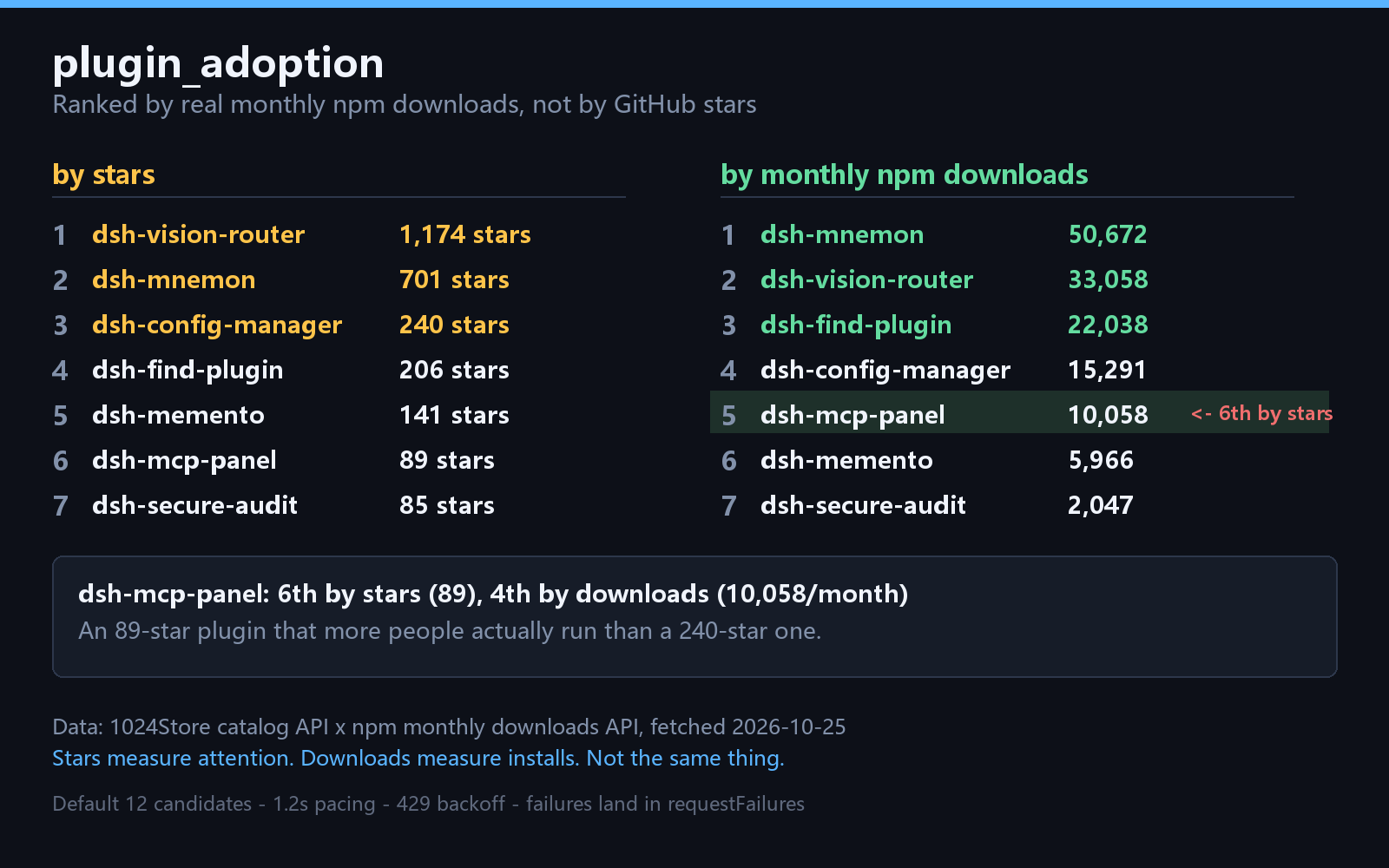
by stars:     vision-router(1174) > mnemon(701) > config-manager(240)
              > find-plugin(206) > memento(141) > mcp-panel(89) > secure-audit(85)

by downloads: mnemon(50,672) > vision-router(33,058) > find-plugin(22,038)
              > config-manager(15,291) > mcp-panel(10,058) > memento(5,966)
              > secure-audit(2,047)
dsh-mcp-panel is 6th by stars (89) but 4th by downloads (10,058/month) 鈥?an 89-star plugin that more people actually run than a 240-star one.
Stars can mislead; downloads don't. This plugin puts both orderings side by side and flags what star ordering under-rates.
Many catalog entries install from a repository rather than a package:
dsh plugin --profile web add github:zhu1090093659/dsh-petA repository is not a package, and its name is the package name only about half the time 鈥?measured on 40 random catalog entries, 20 resolved that way. The rest are forks and re-publications, where the package scope and the repository owner are simply different people:
| repository | package | monthly |
|---|---|---|
zhu1090093659/dsh-pet |
@linxin666/dsh-pet |
131,855 |
PC2005-cloud/dsh-pet |
dsh-pet |
66,953 |
cloader/dsh-taskboard |
dsh-taskboard |
5,978 |
PerryLink/dsh-memento |
dsh-memento |
6,198 |
Guessing from the repository name would attribute the first one's 131,855 downloads to the wrong package, or drop it entirely.
So the name is read from the registry rather than guessed: npm's search
response carries each package's repository.url, and the package whose
repository points at this repository is the one that belongs to it. This is
the same binding the 1024Store catalog uses.
The npm search endpoint is a different service from the catalog API, so this
does not touch the catalog's 50/day anonymous quota. Entries with no
published package still come back empty 鈥?that is a fact about the plugin,
not an error, and they stay in noPackage rather than being counted as zero.
The report says how many entries were recovered this way
(packageResolved), so it is visible when a number came from the registry
rather than from the catalog's own install command.
plugin_adoption()                                 # default: query "dsh", 12 candidates
plugin_adoption({ queries: ['memory', 'tool'] })  # union of several searches
plugin_adoption({ limit: 30 })                    # more candidates (slower, costs quota)
plugin_adoption({ topN: 20 })                     # top 20 in each view
plugin_adoption({ capability: 'badge' })          # skip the 14.9MB bulk file; badges only
plugin_adoption({ capability: 'off' })            # disable the capability dimension
plugin_adoption({ versionLine: 'off' })           # disable the version-line dimension
plugin_adoption({ localVersion: '0.2.1-rc.2' }) # state the host version when it cannot be readThis one came from a real user comment:
"I check which tools version line a plugin rides before I look at downloads. Popular ones get stuck on an old line and will not install 鈥?that is not a network problem. Pinning an exact version beats reinstalling until it works."
His order is version line 鈫?downloads, and this tool only covered the second step. It now covers the first.
It reads peerDependencies["@deepseek-ai/dsh-tools"] from the plugin's
package.json and decides whether the line installed here accepts it.
| status | meaning | what to do |
|---|---|---|
ok |
the range accepts the installed version | install it |
blocked |
the range rejects it | it will not install; the report names which published version does |
no-constraint |
no such peerDependency declared | not constrained by this line (the majority) |
undecidable |
declared, but not a version range (workspace:*, git URL, tag) |
human judgement only |
unknown |
could not find out (no package name / registry silent / over budget) | not "installs fine" |
The host here is 0.2.1-rc.2. semver's rule is that a prerelease is only
accepted by a range that names a prerelease on the same major.minor.patch. So
鈥?verified line by line against npm's own semver:
0.2.1-rc.2  satisfies  "^0.2.1"        -> false
0.2.1-rc.2  satisfies  "*"             -> false   <- looks most permissive, still rejects
0.2.1-rc.2  satisfies  ">=0.1.0"       -> false   <- same
0.2.1-rc.2  satisfies  "^0.2.1-rc.1"   -> true    <- only this shape accepts
That is why dsh-bili-scroll, which declares "*", is reported blocked. It
looks counter-intuitive and matches npm exactly 鈥?and writing "installs fine"
there would send the user into a failed install.
Order: the DSH_TOOLS_VERSION environment variable 鈫?Node resolving
@deepseek-ai/dsh-tools/package.json 鈫?a list of candidate paths (including
Electron's process.resourcesPath, the profile tree, and the install directory).
When nothing readable is found the report says so; guessing a line would make
every plugin look blocked.
鈿狅笍 Known limit: the Desktop build packs
dsh-toolsintoapp.asar, which only the Electron host process can read. On such an install, if the host exposes no resolvable path either, state the version once viaDSH_TOOLS_VERSIONor thelocalVersionargument.
Repository name 鈮?npm package name (guessing hits about 50%). So a name is only
accepted from a trustworthy source: the catalog's install field, or
resolvePackage verifying that the registry's repository.url really points at
this repository. A miss is reported unknown, never guessed 鈥?a wrong name would
read someone else's peerDependencies as this plugin's.
One packument GET per candidate, at most 24 per run; the rest are marked
unknown with the count stated in versionLines.note. Every request shares the
same 1.2s pacing clock.
Stars and downloads both answer "how many people use this". Neither answers "what can it do once installed on my machine". dsh-xray publishes that by scanning each plugin repository, and this plugin joins it onto the candidate pool.
| Level | Meaning (quoted from the dsh-xray legend) |
|---|---|
| C0 | No notable capability surface. |
| C1 | Ordinary: registers tools/services, calls external domains. |
| C2 | Powerful: prompt surface, API interception, subprocess, exec, credential reads or install scripts. |
| C3 | Powerful capabilities combined with sensitive behavior. |
This supplies a dimension neither the store nor the catalog has: of the store's 6,896 plugins only 624 have a download number, and none carries capability data, while dsh-xray knows the capabilities but not who installs them.
The report therefore gains two views:
topByRisk 鈥?ordered by capability risk, worst first (ties broken by downloads)highAdoptionAndHighRisk 鈥?plugins that are both widely installed and
sensitive. This is the genuinely useful line: which widely-installed plugins
can do sensitive things. The threshold is not invented: it is half the
median download count of the candidate pool, and the number used is
reported alongside so a reader can re-judge where the line should sit.The governing rule: ungraded is not safe. A plugin with level: null lands
in the unknown bucket and is never sorted onto the "harmless" side 鈥?the same
principle as "no npm package is not zero downloads".
In dsh-xray, level: -1 is a skipped sentinel (measured: 349 records 鈥?324 skipped: no scannable code, 23 skipped: download failed, 2 scanner
errors). Those were never graded, so they are also unknown, and the original
status is preserved in ungradedReason.
Measured on 2026-10-26: data.json is 14,855,325 bytes, 13.8 s cold,
~1.5 s warm over the GitHub CDN's gzip path; JSON.parse costs 145 ms /
25.3 MB of heap, and ~15 MB stays resident after projection into a Map.
The capability parameter selects the path:
| Value | Behaviour |
|---|---|
auto (default) |
bulk snapshot first; on failure fall back to per-repository badge lookups |
bulk |
bulk only; if it fails there is no capability data, and the report says so |
badge |
skip the bulk file; query badge/<owner>__<repo>.json (~92 bytes, 300鈥?00 ms each). Level only, no flags, and only for candidates that have a repository URL |
off |
disable the dimension entirely |
Every row produced by a degraded path carries partial: true, and
capabilitySource.used states which path ran, so a level-only answer is never
presented as if it were the full picture.
Three separate failure exits, none of which silently becomes an empty array:
requestFailures 鈥?any request failure (including exhausted 429 backoff, timeouts)capabilityFailures 鈥?failures specific to the capability joincapabilitySource.reason 鈥?why the whole dimension is unavailable
(too-large / invalid-json / http-500 / 鈥?A repository missing from dsh-xray is data
(note: "dsh-xray did not index this repository"), reported separately from a
transport failure 鈥?"I could not find out" and "it has none" are different facts.
{
  "sampled": 12,               // candidates found
  "withPackage": 9,            // that have an npm package
  "withDownloads": 9,          // both numbers available, comparable
  "topByDownloads": [          // each row now carries its capability
    { "name": "dsh-mnemon", "downloads": 50672, "stars": 701,
      "starRank": 2, "downloadRank": 1,
      "capability": { "level": 2, "bucket": "elevated",
                      "sensitive": ["exec", "token_env"] } }
  ],
  "topByRisk": [               // second dimension: worst capability first
    { "name": "dsh-x", "level": 3, "bucket": "high", "riskScore": 305,
      "downloads": 45866, "sensitive": ["runtime_patch", "exec"],
      "ungradedReason": null }
  ],
  "highAdoptionAndHighRisk": { // widely installed AND sensitive
    "threshold": 14448,
    "basis": "69 of the candidates have downloads; median 28897, halved",
    "rows": [ /* same row shape */ ]
  },
  "capabilitySource": {        // how this dimension's data was obtained
    "mode": "auto", "used": "bulk", "available": true,
    "graded": 102, "ungraded": 1, "legend": { "0": "C0 鈥?, "3": "C3 鈥? }
  },
  "dangerousCombos": [         // how often each combination occurs here
    { "id": "exec+token_env", "ecosystemCount": 1135, "inCandidates": 5 }
  ],
  "versionLines": {            // third dimension: version line
    "enabled": true,
    "localVersion": "0.2.1-rc.2",              // read, not hard-coded
    "localVersionSource": "env:DSH_TOOLS_VERSION",
    "queried": 24,
    "skippedForBudget": 0,
    "statusCounts": { "ok": 8, "blocked": 6, "no-constraint": 9,
                      "undecidable": 1, "unknown": 0 },
    "blockedPlugins": [                        // will not install, plus what would
      { "name": "dsh-find-plugin", "pkg": "dsh-find-plugin",
        "declaredRange": "^0.1.0-rc.6 || ^0.1.1-rc.1 || 鈥?,
        "installable": { "matching": ["0.1.0"], "highest": "0.1.0", "total": 1 } }
    ],
    "note": null
  },
  "underratedByStars": [       // shift > 0
    { "name": "dsh-mcp-panel", "stars": 89, "downloads": 10058,
      "starRank": 6, "downloadRank": 5, "shift": 1 }
  ],
  "noPackage": ["owner/repo"], // no npm package; listed, never treated as 0
  "requestFailures": [],       // every request failure, never silent
  "capabilityFailures": [],    // capability-join failures, kept separate
  "sources": { "catalog": "...", "npm": "...", "xray": "...", "fetchedAt": "..." }
}
Each topByDownloads row carries both extra dimensions:
{ "name": "dsh-find-plugin", "downloads": 22038,
  "versionLine": {
    "status": "blocked", "pkg": "dsh-find-plugin", "localVersion": "0.2.1-rc.2",
    "declaredRange": "^0.1.0-rc.6 || ^0.1.1-rc.1 || 鈥?,
    "satisfies": false, "blocking": true,
    "installable": { "matching": ["0.1.0"], "highest": "0.1.0", "total": 1 },
    "reason": "the declared range does not accept the installed 0.2.1-rc.2" } }
shift = starRank - downloadRank. Positive means downloads rank it higher than
stars do.
The 1024Store catalog API is anonymous at 50 requests/day, 10/minute (its own docs). One default run = 1 catalog call + at most 12 npm calls.
So this plugin:
requestFailures 鈥?a network fault must not
render as "0 plugins"That last one is the design principle: a report that says "0 plugins" when the network actually failed is more dangerous than one that says "I could not tell", because the first reads as a finding.
| Data | Source |
|---|---|
| Plugin list, stars, install counts | api.deepseek1024.com/v1/plugins/search |
| Monthly downloads | api.npmjs.org/downloads/point/last-month/<pkg> |
| Capability level + flags | unstone.github.io/dsh-xray/data.json (bulk) or .../badge/<owner>__<repo>.json (degraded) |
| Version line (peerDependencies) | the packument at registry.npmjs.org/<pkg> |
| Installed dsh-tools version | the host's own package.json (auto-detected), or DSH_TOOLS_VERSION |
All are public read-only endpoints. No authentication.
noPackage 鈥?"not published" and "nobody downloaded it" are different facts.queries; it is not the full catalog.SENSITIVE_FLAGS) and the risk ordering weights are
this plugin's judgement, not dsh-xray's; only the C0鈥揅3 grades are the
publisher's. The two are labelled separately in the code so you can disagree
with one without discarding the other.sensitive is always
empty on that path 鈥?empty means "not fetched this time", not "no sensitive
capabilities".latest version's peer block (that is what gets
installed). Historical versions declare different ranges; this report does not
expand them one by one.unknown, not
"installs fine".node --check index.js && for f in lib/*.mjs; do node --check "$f"; done
node --test test/logic.test.mjs test/capability.test.mjs test/version.test.mjsThe tests are offline on purpose: running them against the live API would spend the caller's 50/day anonymous quota, which is exactly what this plugin exists to avoid.
dsh-plugin-trust-audit 鈥?audit whether DSH plugin HTTP routes are actually fenced.
MIT
CLASSIFICATION EVIDENCE
系统优先读取 GitHub Topics,再与站内分类词典和词根规则比对。当前命中: deepseek-harness。
morluto
Reverse engineer anything with agents, from app behavior down to native binaries.

deepseek-ai
DeepSeek Harness: Everything is a Plugin.

nexu-io
The 1st Collaborative AI Design Agent Workspace. Local-first and open source. Create motion, prototypes, websites, apps, dashboards, presentations, images, and videos with your team and AI agents. Share work, exchange feedback, and iterate together in one workspace.