dsh-context-guard
npm package: @2jumpsina/dsh-context-guard · 中文
A DeepSeek Harness plugin that tells you to wrap up and start a new session before the session gets too long.
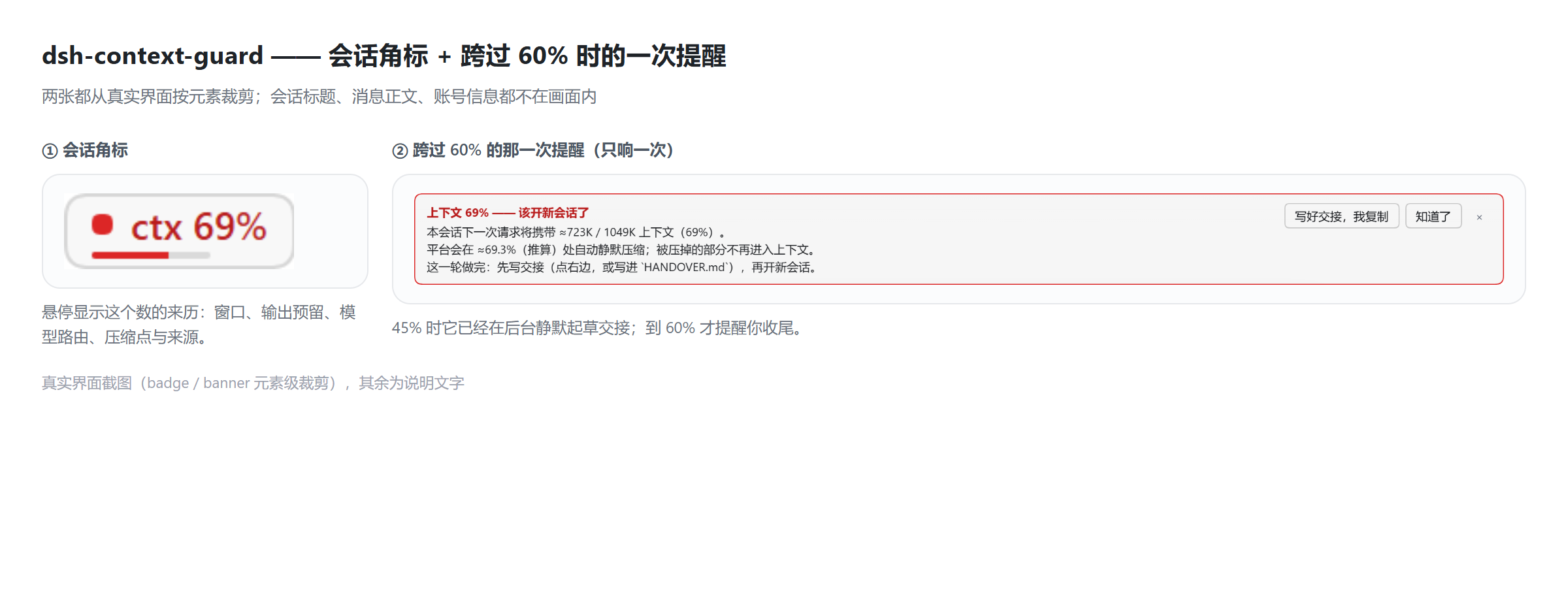
It consumes the contextPressure projection that the official dsh-token-meter has already computed, and after a turn has ended it speaks up on two thresholds: "write the handoff into a document first, then start a new session." It then helps turn that sentence into an action — once the threshold is crossed it drafts a handoff block into the session working directory.
Context tax = 0: it registers no model-facing tool, injects no prompt section, and sends no extra request. The host does the arithmetic, the UI does the talking.
🆕 Current release is live on npm latest (0.7.x): 45% silently drafts the handoff, 60% is the only reminder;
the compaction point shows up in the badge tooltip and in the banner body (computed live as
min(window×0.8, window − reserve − 64K), with its source; marked "estimated" when the platform's
compaction config is unreadable); and the moment the platform compacts, the pre-compaction reading is
captured into the compaction ledger inside HANDOVER.md.
Since v0.5.0 the WeChat push and cross-session trend are gone (their config keys retired from the
schema in v0.7.2; leftover values in old profiles are ignored safely). See HANDOVER.md §46–§48.
⚠️ Do not run npm i dsh-context-guard — that unscoped name is a third party's package
(by greenlv). This plugin's name is scoped: @2jumpsina/dsh-context-guard, published on npm
(see Install).
🙂 Got it running? Send me a line — what I want most is to hear what could be better.
One line is enough: what it got right in your setup, and what felt off.
⚠️ It writes to your working directory (read this before installing)
- On by default (
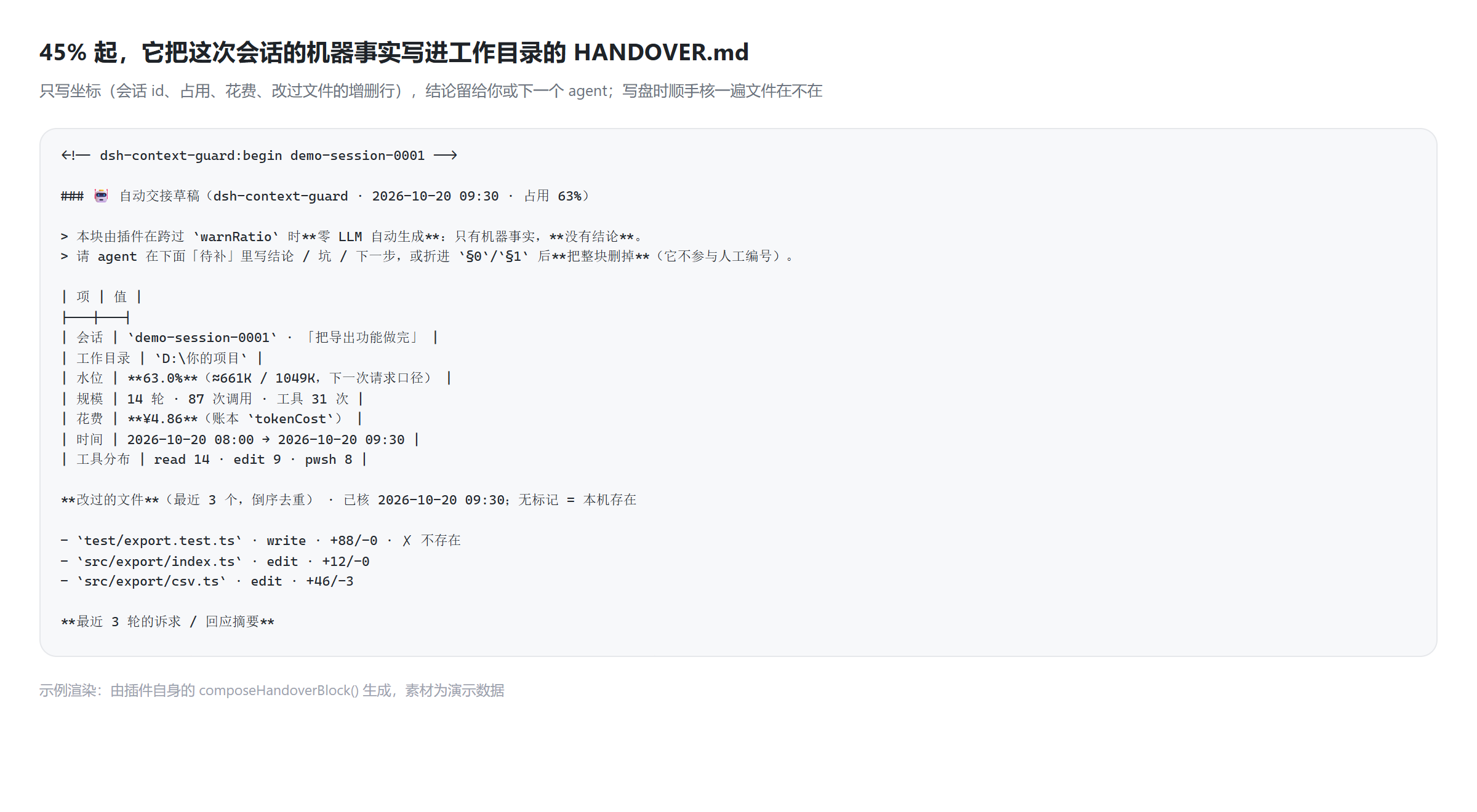
handoverOnWarn: true). When a session's occupancy crosses warnRatio (default 45%), the plugin creates/rewrites handoverPath (default HANDOVER.md) in that session's working directory, and then refreshes it every further 5 percentage points.
- What it writes are machine facts: session id, title, working directory, occupancy, turn/call counts, ledger cost, the files this session wrote, previews of the last few prompts and replies, plus empty "to be filled in" slots for the agent.
⇒ It may contain sensitive content (file paths, fragments of your questions and replies), and it may end up committed by git.
- Suggestions: add
HANDOVER.md to your .gitignore; or point handoverPath at a location outside any repository; or simply set handoverOnWarn: false.
- Boundaries: a missing parent directory is refused; an existing target that is not a text file (
.json/.yml/…) is refused; a symlink pointing elsewhere is refused; writes are atomic (temp file + rename) with tight permissions (0o600). Any failure is recorded as status only — it never affects the badge, the banner, or the push.
Why this plugin has to exist
In one line: a long session is not a technical failure, it is a bill that grows every turn. This plugin
exists to put that bill in front of you at the one moment you can still act on it — after a turn has ended and
before the next request goes out.
The problem is measurable
Cost ≈ (average prompt size) × (number of calls) × (unit price). A long session pushes the first two factors up
at the same time, and the unit price itself rises with occupancy. Measured against the ledger of the machine
this plugin was calibrated on (its local session-projection cache: 84 sessions / 14 days, ¥252.29
self-reported) and the official DeepSeek pricing table:
| Measurement |
Value |
Self-check (price table × contextTimeline.cost, against the ledger total) |
¥254.29 vs ¥252.29 ⇒ 0.8% deviation; per-request rows cover 85.4% of the total |
| Unit price by occupancy |
¥0.011/call at 0–10% → ¥0.045/call at 70–80% (4.2×) |
| Where the historical spend sits |
calls at ≥40% occupancy: 37.4% of spend · at ≥60%: 20.0% |
| Session peaks |
Observed 75/75 sessions never exceed ~80%; the real point comes from the formula (≈ 67.8% on this machine's deepseek-flash) |
| Interruption cost, if the line is drawn at 40% / 50% / 60% |
0.78 / 0.57 / 0.50 prompts per day |
And one real session, from the very repository this plugin was built in: 584 calls, 274M tokens, ¥31.66 — of
which 98.6% was re-reading context and 0.17% was model output. That is the failure shape being addressed here:
no crash, no error message, just an invoice.
Why this guard is the cheap half of the trade
The formula above has a shape worth spelling out. A session's total is
total ≈ Σ over turns ( prompt_i × unit_price(occupancy_i) )
and both factors move the same way: prompt_i grows monotonically with every turn, and the unit price
itself rises with occupancy (measured above: ¥0.011/call at 0–10% → ¥0.045/call at 70–80%). A session
therefore does not get linearly more expensive as it runs, it gets super-linearly more expensive —
which is why the last third of a long session can cost far more than the first third while containing the
same number of turns.
That is the entire reason this plugin is worth installing: its marginal cost is exactly zero.
- It registers no model-facing tool, injects no prompt section, and sends no extra request ⇒ it adds no
tokens to any request — it does not appear in the ledger at all.
- The only thing it ever costs you is the handoff at the end, and that handoff is not a fee paid to this
plugin: it is work you would have to do anyway, usually worse (from memory, after the session has
already been abandoned).
- It speaks at the turn boundary. A warning inside a turn is useless — that prompt is already on the
wire and already paid for; a warning two turns later is an invoice you can no longer avoid.
So the trade is not "spend money to save money". It is: put a free readout on a bill you are already
paying, at the only moment when the number can still change the decision.
Why nothing else already catches it
- The platform compacts; it does not negotiate. The automatic point is
min(window × 0.8, window − reservedOutput − 65,536)
(≈ 67.8% on this machine's deepseek-flash), and it fires without asking. Compaction is a safety net for the session, not a warning to you — by
the time it fires you have already paid for the whole climb. Since v0.6.1 the hard-tier banner prints that point
explicitly; what it compresses away is gone — the only trace is a ledger row if one was written (the wording
deliberately does not claim "the reading is lost forever").
- The model cannot be the meter.
projectedTokens is computed by dsh-token-meter from the real request;
the model cannot see how large its own prompt is, and a warning is only meaningful after a turn ends (that
turn's prompt is already on the wire). Worse, any mechanism that makes the model "mind the context" has to
inject a prompt section or register a tool — that is adding context tax to solve a context-tax problem.
- You have no readout. Occupancy is observable, but "time to wrap up" is not one reading: it needs
hysteresis, a cooldown, edge triggering, cross-session counting, and it has to fire when you open an
already-full historical session. Nobody watches a percentage while working.
What it does instead — and deliberately does not
- Context tax = 0: no model-facing tool, no prompt injection, no extra request. A guard against context bloat
must not itself consume context.
- It only consumes what the official meter already computed — it does not re-measure, estimate or guess.
- It speaks once per level, at the end of a turn: two levels + hysteresis + edge trigger + cooldown.
- fail-closed: with no denominator it does not judge at all, and the badge shows
ctx — instead of 0%.
- It turns the sentence into an action: crossing
warnRatio drafts a machine-facts handoff block (session,
occupancy, ledger cost, the files this session wrote, previews of the last few prompts/replies, plus
"to be filled in" slots) into the session working directory — zero LLM, zero extra request.
- No network at all (v0.5.0 removed the WeChat push); capabilities are
fs-read / fs-write only.
What this section does not claim
- The savings are a counterfactual upper bound, not a promise. Replaying this machine's ledger: the 2741
calls made at ≥40% occupancy would have saved ¥59 (23%) had they happened at 0–20%; the ≥60% batch would
have saved ¥34 (14%). Wrapping up is not free — it costs exactly one handoff. The only claim is that this
decision is better made with the number in front of you.
- The thresholds are a calibration, not an optimum. 0.45 / 0.60 come from those 84 sessions; they are
defaults, and every one of them is configurable.
- The sample is one machine, one provider, two weeks. Prices and compaction behaviour change.
- It does not judge whether your task is worth finishing. It says one thing: continuing from here costs
several times more per turn than starting fresh — and here is the handoff draft.
What it does
| Half |
What it does |
host (lib/index.js) |
Subscribes to ctx.sessionProjections.onChanged and feeds contextPressure to the pure policy; settles each turn on turn/end; owns the settings; judges once immediately on session/created (new or restored from storage); folds compaction/end and request/header into the decision; registers the verdict as the contextGuard wire projection for the browser half; registers GET /api/context-guard/state (a read-only debug mirror); extrapolates the verdict to WeChat when configured; and drafts the handoff block when a threshold is crossed |
client (lib/client.js, a hand-written single-file bundle) |
Session-header badge (live occupancy; numbers only, never speaks) plus a one-shot banner on threshold crossing (ratio + next step + pointer to the handoff document); level/turn/cooldown come only from useProjection("contextGuard") — read-only, no local state machine, no thresholds, no extra requests (see the Architecture section below) |
Behaviour notes:
- Judgement timing = on projection change (not
turn/end): contextPressure updates after every
request and the plugin judges right then; turn/end only advances the turn counter and decays the
cooldown, while compaction/end and request/header feed the decision.
⚠️ Earlier revisions here claimed "never mid-turn", which did not match the implementation. After the
2026-10-17 code review the decision was keep the implementation, fix the docs: moving judgement to
turn/end means that if that event is ever missed the plugin goes completely silent (a miss), while
judging on projection change at worst warns slightly early. See HANDOVER.md §33.
- Speaks once: two levels + hysteresis (re-armed only after falling back below
warn − hysteresis) + edge triggering + a cooldown of N turns.
- At a level crossing you get two choices:
Write the handoff, I will copy it (write one machine-facts draft right away and surface a copy-ready opening line) and Got it (just close, no side effect).
- fail-closed: with no denominator (
contextWindow absent) it does not judge at all, and the badge explicitly shows ctx — instead of pretending to be 0%.
Architecture (v0.4.3): the host judges, the browser only reads (one decision)
One place decides, one place displays, and a single wire projection links them:
| Layer |
Where |
Responsibility |
| Decision |
lib/engine.mjs (host only) |
The state machine is a pure fold (init + apply(state, event)): level / armed / turn / cooldown / hysteresis are computed once, and compaction/* folds into that state |
| Projection |
lib/index.js (host) |
Registers the verdict as the contextGuard wire projection: { level, armed, turn, cooldown, ratio } — flat JSON, same reference while unchanged |
| Display |
lib/client-source.js (browser) |
useProjection("contextGuard"), read-only (badge + one-shot banner); no thresholds, no state machine, no extra requests |
| Debug mirror |
GET /api/context-guard/state |
A read-only mirror: current host config / recent decisions / ledger counters / handoff stats. The browser half no longer copies thresholds from it |
Two things this buys:
- One decision. The browser half used to carry its own state machine and copy the thresholds from
the state route on boot ⇒ two cooldowns, two hysteresis rules, and
settleTurn wired to a banner
button (one click could advance the turn counter client-side). The decision now lives only in
lib/engine.mjs and is not even in the bundle — structurally: test/client-sync.test.mjs also
statically bans the hostSync / setConfig / settleTurn identifiers.
- It shows what it was told. The debug surface
window.__DSH_CONTEXT_GUARD__.store.dump() (all
sessions) and viewOf(sessionId) (one) records what the host projection said, not what the
client computed. When the projection is absent (older host / no token-meter), the badge still shows
occupancy but no banner appears — better to stay quiet than to reintroduce a second judge.
Install
⚠️ Do not run npm i dsh-context-guard. The unscoped name
dsh-context-guard belongs to a third party (greenlv <lgr5945@gmail.com>; latest 0.2.1, now
deprecated in favour of dsh-completion-guard). That command installs their plugin, not this one.
This plugin's name is scoped — @2jumpsina/dsh-context-guard — and is published on npm.
Install into DSH (recommended)
dsh plugin is a thin wrapper around pnpm: it runs package management inside the profile and then
registers the new bundle. One command, everything else is automatic:
dsh plugin --profile web add @2jumpsina/dsh-context-guard
What DSH does for you afterwards (all verified on a live profile): adds the dependency to the
profile's package.json · appends the package to dsh.profile.bundles — that is what makes it an
actual profile layer · applies the package's cordis.patch.yml to mount the host half, and its
dsh.client declaration to inject the browser half.
⚠️ Restart dsh afterwards. Source changes do not hot-reload, and a newly installed layer is
applied at boot.
Installing the package is not the same as mounting it — npm i alone only puts files in
node_modules and changes no profile.
Install from this repository instead
dsh plugin --profile web add git+ssh://git@github.com/2JumpSinA/dsh-context-guard.git
Requires git on PATH and a GitHub SSH key. ⛔ The github: shorthand
(dsh plugin --profile web add github:2JumpSinA/dsh-context-guard) resolves to an HTTPS clone,
which is unreliable on some networks (it fails with a confusing git error and no hint about
transport) — prefer the git+ssh:// form or the npm package above.
Plain npm (no DSH underneath)
If you are only fetching files and mounting them yourself:
npm i @2jumpsina/dsh-context-guard
During local development (not published, mounted into a profile with a junction) this is also common:
# junction the repo into the target profile's node_modules (replace the paths for your environment)
New-Item -ItemType Junction `
  -Path   $env:DSH_HOME\profiles\<profile>\node_modules\@2jumpsina\dsh-context-guard `
  -Target <repo path>
Then append an insert entry to that profile's cordis.patch.yml (the user patch layer):
- insert:
    - id: context-guard
      name: '@2jumpsina/dsh-context-guard'
⚠️ Do not put this package into the profile's dsh.profile.bundles — that fails with cannot resolve profile bundle.
⚠️ With a junction, Node resolves node_modules upward from the real path ⇒ the repo needs its own dependencies (or let DSH resolve them from the install location).
Configuration
Editable on the settings page, all applied live; every config field is volatile ⇒ changing them needs no restart (changing source, however, does — see below).
| Field |
Default |
Range |
Meaning |
enabled |
true |
bool |
Master switch |
locale |
auto |
auto|zh|en |
Copy language; auto is resolved per half (the host reads the session's first input, the browser reads navigator.language, both fall back to Chinese). ⚠️ This field only affects the host side (handoff draft / host logs / push); the browser side is forced by the pre-load escape hatch only — see Language |
warnRatio |
0.45 |
0.1–0.95 |
Occupancy (projectedTokens / contextWindow) at which "time to wrap up" fires |
hardRatio |
0.60 |
0.1–1 |
"Time to start a new session"; must be > warnRatio |
hysteresisRatio |
0.05 |
0–0.2 |
Hysteresis: re-arm only after falling back below warn − this value |
cooldownTurns ~ |
5 |
0–100 |
no-op since v0.7.1: the cooldown gate was removed (a crossing already speaks once per arming cycle) |
onResume |
true |
bool |
Also warn when entering an already-high historical session |
respectCompaction |
true |
bool |
Host log only: skip the decision log entry right after a compaction; the badge/banner still reflect the real level |
handoverOnWarn |
true |
bool |
Auto-draft the handoff block once warnRatio is crossed |
handoverPath |
HANDOVER.md |
string |
Relative to the session working directory, or an absolute path |
handoverRefreshPercent |
5 |
1–25 |
Refresh the draft every additional N percentage points of occupancy |
handoverTurns |
6 |
1–20 |
How many "prompt / reply" previews the draft carries |
handoverFiles |
12 |
1–50 |
How many recently written files the draft carries |
The schema floor for warnRatio is 0.1: a value like 0.05 stops the entire plugin from mounting
(ValidationError: invalid config: $.warnRatio expected number >= 0.1, and the state route then 404s).
Language
All user-visible copy is bilingual (Chinese + English): the banner, the handoff draft, host logs and
the badge/banner UI text. Default is auto, and the two halves resolve it separately — they do not
look at the same clues:
| Half |
What auto looks at |
Fallback |
| Browser (badge tooltip + banner) |
the pre-load escape hatch window.__DSH_CONTEXT_GUARD__.config.locale > navigator.language (zh… ⇒ Chinese, anything else ⇒ English) |
Chinese |
| Host (handoff draft + logs + push) |
whether that session's first user input contains Chinese characters (titleInput, read from the projection registry's host state via stateOf) |
Chinese |
- Browser-side language = pre-load escape hatch
config.locale > navigator.language > zh. The
hatch has to be injected before the bundle loads (addInitScript and friends): the language is
frozen at module-evaluation time. It is absent by default ⇒ auto almost always follows the browser
language.
- The host-side
locale only affects the host's own surfaces (handoff draft, host logs). Since v0.4.3 the browser half no longer reads the language from the host
(that GET /state path is gone), so "set locale: 'zh' and both halves speak Chinese" no longer
holds — forcing the browser side is only possible through the pre-load hatch above.
- Settings-page field descriptions are always written as
English / 中文 in one line: the DSH config
schema is static load-time metadata with no per-locale description mechanism, and the settings page
has no idea which session you are looking at. (If DSH ever grows per-locale descriptions, those
strings move into the string table and this note goes away.)
- Escape hatch: when there is no session to look at (startup logs, settings page, the state route),
the host half reads
DSH_CONTEXT_GUARD_LOCALE=zh|en; any other value is ignored.
- Machine-facing surfaces stay English in every language: JSON keys on the state route, config field
names, and log
codes. Only sentences meant for humans get translated.
- The sample draft block further down is what a Chinese session produces; an English session renders
the same structure with English labels.
Host state route
GET /api/context-guard/state — a read-only debug mirror: it shows the host's current decision settings and counters to curl, a troubleshooting session, or the acceptance scripts.
⚠️ Since v0.4.3 the browser half no longer takes its data from here (level/cooldown come over the contextGuard projection — see Architecture). Breaking this route therefore cannot break the badge or the banner, but it does cost you one pair of eyes.
{
  "plugin": "context-guard",
  "at": 1790000000000,
  "config": { /* the table above; handoverPath returns a relative/file name only, never an absolute path */ },
  "recent": [ { "sessionId": "…", "level": "warn|hard", "ratioPercent": 52, "title": "…", "body": "…" } ],
  "ledger": { "written": 1, "failed": 0, "unchanged": 0,
              "last": { "at": 1790000000000, "status": "appended", "row": 1 } },
  "handover": { "enabled": true, "path": "HANDOVER.md", "refreshPercent": 5,
                "written": 1, "failed": 0, "skipped": 0,
                "last": { "status": "appended|replaced|error|skipped", "path": "HANDOVER.md", "bytes": 1234, "error": null },
                "history": [] }
}
Automatic handoff draft
When warnRatio is crossed (or a session already above it is opened), the plugin maintains a marked draft block in the session working directory:
<!-- dsh-context-guard:begin session-… -->
### 🤖 自动交接草稿(dsh-context-guard · 时间 · 占用 52%)
… 机器事实表格 · 改过的文件 · 最近几轮摘要 · 「待补」空槽 …
<!-- dsh-context-guard:end -->
(The block's labels are Chinese because that is what the plugin writes today — the facts themselves are language-neutral: a machine-facts table, the files changed, the last few turns, and empty slots.)
- Idempotent: one block per session, replaced wholesale on refresh, never appended twice; a human can delete the whole block.
- You can also trigger it by hand (v0.3.5): the banner button
Write the handoff, I will copy it issues POST /api/context-guard/draft, which skips the "only refresh after another step" gate, writes the block right away, and returns a copy-ready opener:
@HANDOVER.md Continue from this handoff. Fill in the "to fill in" slots first, then carry on with the task.
(Like the state route, this route has no plugin-level authentication: the response carries a file name only, never an absolute path.)
- Machine facts only, no conclusions — the plugin has no idea what you did. Have your agent fill in the conclusions / pitfalls / next steps in the "to be filled in" slots, or fold the block into your own handoff document and delete it.
- Where the material comes from (verified on a live machine 2026-09-30; fixed in 0.3.2 — the first version published under the
@2jumpsina scope): the machine facts come from the host state source of truth — the registry's sessionProjections.stateOf(session, key) — and not from the wire view pushed by projection changes.
Why: once the on-demand detail channel is armed, the wire view of contextTimeline (registered by plugins such as dsh-context) is a slim head: occupancy, size, tool mix and cost are all there, but fileOps is not — the heavy collections exist only in the unit state. v0.3.0 read the wire view only ⇒ "files changed" was always 0 (identical for a restored session and a running one; it was never a difference between those two paths); and turnOutline's wire view is an array while v0.3.0 read {turns} ⇒ "last few turns" always printed "host did not provide". Both are fixed now, each guarded by unit tests and the self-test.
- Dependencies and degradation:
fileOps and the tool mix depend on a plugin that registers contextTimeline (e.g. dsh-context); cost depends on tokenCost (e.g. dsh-damage-pulse). When they are absent, those sections render empty — the plugin invents nothing and does not fail. And if the host registry has no stateOf (older harness), it falls back to the wire view, i.e. v0.3.0 behaviour.
How faithful is the handoff? (v0.3.6 — this section matters more than the feature list)
| What |
Fidelity |
Why |
| session / occupancy / spend / changed files / time |
high (verifiable) |
all of it comes from official projections; the plugin neither rewrites nor estimates. If a number is wrong, the projection is wrong — not the prose |
| the last N turns summary |
medium (truncated) |
it is a condensed "prompt / response" list, not the original text ⇒ treat it as a clue, not as evidence |
| to fill in (conclusions / pitfalls / next steps) |
empty |
the plugin has no idea what you did. Those three slots belong to whoever saw the whole conversation — you, or the old session's agent |
Two consequences worth stating plainly:
- A new-session agent that only sees the summary will infer. It never saw the failed attempts, the rejected
approaches or the verbal agreements in those dozens of turns ⇒ read its conclusions as a draft and correct them.
- The old session's agent writes better conclusions (it still has the context). The button covers the zero-cost
machine facts; for conclusions, ask the old session for one line and write them outside the block.
Manual notes now survive refreshes (v0.3.6): the "to fill in" area has its own sub-markers
<!-- dsh-context-guard:todo:begin/end -->; a refresh updates only the machine facts above it and leaves the
manual content byte-for-byte intact. (Blocks written by ≤0.3.5 have no sub-markers and are rescued once via a
- [ ] line anchor.)
Thresholds and the reasoning behind them (why 0.45 / 0.60)
- Occupancy =
projectedTokens / contextWindow (the official definition: how large the next request's prompt is, output excluded). Always a ratio: switch models and the window switches with it.
- Cost rises with occupancy: fitting per-call cost against occupancy using official pricing, a call in the high band costs several times one in an empty session; wrapping up later costs more, and starting a new session earlier saves more at the price of exactly one handoff (so keep it short).
- The 0.60 hard line deliberately precedes the platform's own move: the automatic compaction point is not a fixed 80% but
min(window × 0.8, window − reservedOutput − 65,536). On this machine's deepseek-flash (1,000,000 window / 256,000 output reserve) that is
67.8% (678,464 tokens) — matching what the real machine does. Putting hard at that point would race it for the same moment, and
respectCompaction: true (host-log only since v0.7.1) would keep the host silent right after a compaction ⇒ host decisions and the
UI could drift apart, which is why hard still sits before the compaction point.
- Speaking the truth (v0.6.1): the hard-tier body prints the threshold computed on this machine with the same formula (e.g. "about 67.8%");
when the window or the output reserve is unknown it prints no number and only says "the platform silently compacts".
The wording deliberately does not claim "the reading is lost forever" — the ledger keeps a row (if one was written).
- v0.6.12: universality boundary (it adapts to machine and model, with one unreadable input).
The window comes from
contextPressure.contextWindow, the output reserve from request/header.config.maxTokens
(falling back to the adapter's defaultMaxTokens) — both are read at runtime, per session and per route, so a
different machine or model is picked up automatically. But dsh-compaction-basic's thresholdRatio (0.8) /
headroomTokens (65,536) / modelPolicies live on a per-agent-leaf service that a third-party plugin cannot read
(verified: neither root-context injection nor the agent's scoped context exposes it), so the point is computed from
factory defaults — if you override those three in your profile, this plugin's number will be off. The copy
therefore always says "estimated" and names the source; it never claims exactness. The badge tooltip also shows the
environment (provider/model · agent preset).
- Division of labour (v0.6.3):
warnRatio (0.45) = draft the handoff silently, no banner any more;
hardRatio (0.60) = the only reminder (shown once when crossed, until you dismiss it).
Compaction ledger (v0.5.0)
After the platform compacts, the pre-compaction reading is gone for good (the platform eats its own evidence). On compaction/end the plugin appends one row to a ledger inside the working directory's HANDOVER.md, in its own marker block, so a draft refresh can never overwrite it:
<!-- dsh-context-guard:ledger:begin -->
### 🗜️ Compaction ledger (appended automatically, do not edit)

| # | time | session | peak before | size | total spend | files | event |
|---|---|---|---|---|---|---|---|
| 1 | 2026-10-19 15:42 | a4b6cffb | 79.8% | ≈160K/1000K | ¥1.84 | 5 | 7f19c0a1 |
<!-- dsh-context-guard:ledger:end -->
Three invariants: idempotent by compactionId (a repeated delivery writes one row), peak before compaction (not the lower value afterwards), and failures are never silent (a failed write shows up in /state.ledger.failed). After a compaction the banner's degraded state adds one receipt line: "before compaction 79.8% · ledger row 1 · now 20%".
It is decoupled from handoverOnWarn: turning off auto-drafting turns off prompts, not the record.
Security and privacy
- The state route has no plugin-level authentication: it is registered on the host webServer (the same access control as DSH Web). What the plugin does defend is: relative/file names only (never a local absolute path),
Cache-Control: no-store, and no CORS headers. Do not expose DSH Web on 0.0.0.0.
- The side effect of writing files is the warning at the top; the write path comes from your own settings, never from remote input.
- The browser half's debug handle
window.__DSH_CONTEXT_GUARD__ is read-only since v0.4.3: store.dump(), viewOf() and a config getter, no override(). Object.defineProperty pins it so it cannot be replaced wholesale. It is available inside the page only and grants no privilege (that code already runs in your DSH Web page).
- The plugin does not use the network, does not call any LLM, and does not send session content (v0.5.0 removed the WeChat push entirely).
Tests and local acceptance
npm test          # unit tests + the "bundle is byte-identical to source" check
npm run build     # regenerate lib/client.js (required after changing lib/client-source.js or lib/policy.mjs)
Requires Node ^22.19.0 || >=24.0.0.
Troubleshooting (every one of these was hit for real; written down so they are not repeated)
- A
.volatile() field is a reference, not a value: reading config.warnRatio inside apply(ctx, config) is always undefined ⇒ it silently falls back to the default. Read each field as isVolatile(v) ? v.get() : v (see plainConfig() in lib/policy.mjs). That is how the settings page can show 0.33 while the plugin judges at 0.45.
- Source edits do not self-heal: a running instance neither re-reads the profile's
cordis.patch.yml nor reloads already-mounted modules ⇒ after changing config or source, restart that dsh process (the browser half is the opposite: the server re-reads the bundle per request, so a page refresh is enough).
patchReload: live is not a file watcher: it governs that one composition, not hot reloading.- With a junction install, Node resolves dependencies from the real path ⇒ the repo needs its own
node_modules (or let DSH resolve them from the install location).
--profile is a top-level flag: dsh --profile <p> --port <n> is correct; dsh web --profile <p> fails with select a profile only once.
Uninstall
If you installed it with dsh plugin add (the normal path): one command — the bundle entry and the
dependency are reconciled away automatically — then restart that dsh process.
dsh plugin --profile web remove @2jumpsina/dsh-context-guard
If you mounted it by hand with a junction (local development): delete that insert entry from the
profile's cordis.patch.yml (and any - id: context-guard config entry the settings page may have
written into the same file), remove the profile's node_modules\@2jumpsina\dsh-context-guard, then
restart that dsh process. (Remove a junction with cmd /c rmdir — that deletes the link, not
your repository.)
License
MIT


