

Agent 与会话
插件

nuwa-skill
alchaincyf
你想蒸馏的下一个员工,何必是同事。蒸馏任何人的思维方式——心智模型、决策启发式、表达DNA。Distill how anyone thinks.
PROJECT TOPICS
INSTALL REFERENCE
dsh plugin --profile web add github:2310770803/dsh-session-copy
该命令指向仓库当前默认分支;尚无绑定当前 commit 的完整验证结果。
PROJECT README
English | 中文




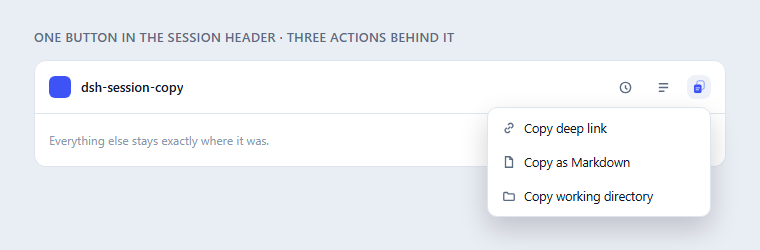
One button in the DSH Web session header. Click it and pick what to copy — deep link, whole conversation as Markdown, only the messages you tick, or working directory. No more row of flat buttons competing with the toolbar.
The session header is a crowded strip of icon buttons, and copying a conversation out of DSH used to mean three of them. This plugin folds the three into one 28-pixel button whose menu carries the same actions, so the header gains nothing but a single icon.
The one that actually takes work is Markdown. A session log is not a chat transcript: it is a stream of tool calls, retries, pruned rows, injected context and — after a while — compaction checkpoints. This plugin reconstructs the conversation from that stream on the Host side and hands back clean Markdown.
| Menu item | What you get |
|---|---|
| Copy deep link | @[title](dsh-session:<base64url(session id)>) — the canonical DSH session mention. Paste it into any composer and the Host attaches that session's snapshot, so another conversation can read this one. |
| Copy Markdown | The whole conversation as clean Markdown on the clipboard: one section per message, every assistant step kept, tool output and reasoning folded away, compaction points marked, code fences balanced. |
| Export Markdown file | The same document saved as a .md file. Use this for anything long — a clipboard write is the part that fails first, and the file has no length cap. |
| Select messages… | Opens a timeline picker; tick the messages you want and copy or export only those — the QQ/WeChat multi-select gesture. |
| Copy directory | The session's cwd, read from the Session list projection with the Host snapshot as fallback. |
Every action reports back in a small notice — including the character count, so you can tell a 400-character session from a 400,000-character one.
A clipboard write is the weakest link in "copy the whole conversation": browsers cap or refuse a single write of a few hundred kilobytes, and a silent truncation looks like the plugin lost your history. Measured on a real 4.3 MB session log:
| Characters | Complete? | |
|---|---|---|
| Clipboard copy (capped) | 212,330 | no — trimmed at the cap |
| File export | 778,435 | yes |
So the clipboard action keeps its cap and says when it trims, while the export action asks the Host to lift it (8,000,000 characters, still finite so a corrupt log cannot exhaust memory) and hands you the file. The picker has the same pair of buttons: Copy and Export .md.
A long session usually has one stretch worth sharing: the debugging thread, the decision, the answer. Select messages… opens a timeline of every message with its role, a one-line preview and its size, and copies only what you tick.
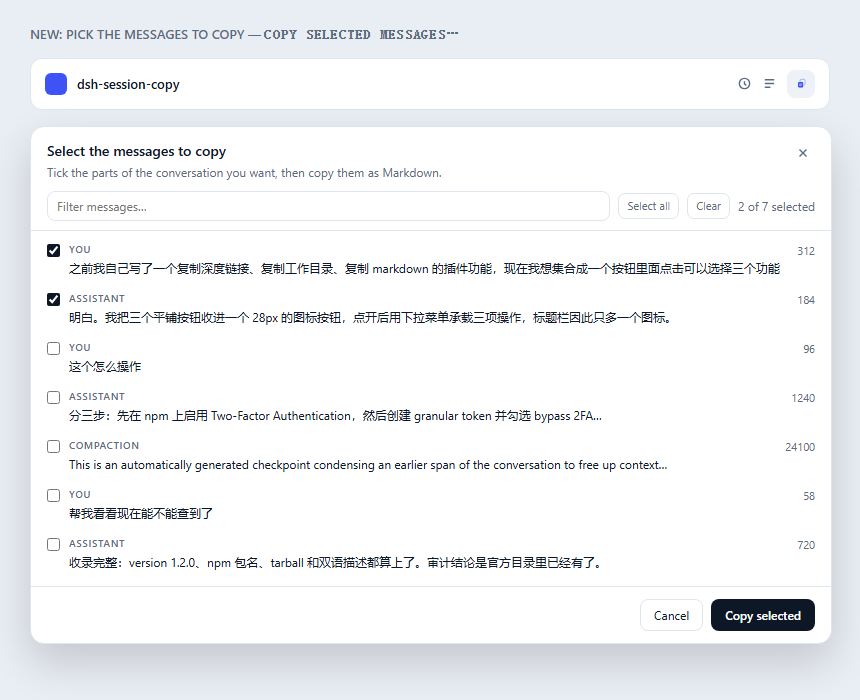
Space toggles the focused row, ↑/↓/Home/End move
between rows, Ctrl/⌘+A ticks everything visible, Escape closes.4 of 7 · 1,832 characters — both the count and the size of
what you are about to paste.> Excerpt: 12 of 340 messages selected, so a
pasted fragment is never mistaken for a truncated export.dsh plugin add dsh-session-copyThe desktop app has its own plugin manager: open Settings → Plugins and install from there, rather than with the CLI (which targets a different profile while the app is running). Then restart DeepSeek Harness — the Loader assembles its plugin list at boot, so a reload of the page is not enough.
node scripts/install.mjs --check    # report profile health, change nothing
node scripts/install.mjs            # install or refresh in the current profile
node scripts/install.mjs --uninstallThe catalog install path, for hosts that would rather not build from source:
dsh plugin --profile web add \
  https://github.com/2310770803/dsh-session-copy/releases/latest/download/dsh-session-copy.tgz
The asset name is deliberately version-free. A releases/latest/download/ URL
resolves latest at request time but takes the filename literally, so a
versioned filename would work until the next release and then quietly 404; the
release workflow re-uploads dsh-session-copy.tgz on every tag to keep that URL
stable.
Three decisions here are the difference between a usable export and a broken one, and each of them replaced a bug:
Every assistant step is kept, not just the last one. A turn is not one reply
— an agentic turn is twenty model steps interleaved with tool calls. Keeping only
the final assistant/message of each turn discarded 41% of the assistant text on
a real session (15,717 of 26,657 characters), and lost all 29 intermediate
messages in one turn. All of them are emitted, in order.
Compaction is marked, not swallowed. When DSH compacts a conversation it
writes a compact-checkpoint message and a compaction/summary event, and the
pre-compaction turns stop being what the model sees. Dropping those as "injected
context" makes a long session export with its history silently missing — which
reads as "the copy is broken". They are rendered as an explicit
Conversation compacted marker instead, so an intentional summary is never
mistaken for lost content.
Fences are balanced across the document, not per message. A message that ends inside a fenced code block used to get a synthetic closing fence, which left the next message's fences mismatched; one 21 KB export came out with 34 stray fence markers. Fences are tracked over the assembled document so what you paste renders as written.
A selection is trusted only as indices. The picker sends back the positions it showed; the Host drops anything out of range, repeated or non-integer rather than letting it shift the result onto a different message, and reports how many were discarded. A transcript can then never silently paste someone else's turn.
Reading is also bounded and version-tolerant:
sessionQuery.readSession (the whole raw log) is the source;
readSurface — what the model currently sees — is only the fallback. This
matters because a compaction replaces everything before it: the surface has
no pre-compaction turns at all. On one real session the surface held 247
messages across turns 14–22, while the log held 398 across turns 1–22 plus the
four compaction markers.textarea + execCommand path
(the one that survives long text and a blurred window), then the async
Clipboard API, twice. DSH's own bundled writer returns false as soon as
navigator.clipboard.writeText throws and never falls back, so delegating to it
alone was a trap.The repository publishes a single-plugin plugin market index — the format
DSH's Plugins → Discover tab and the plugin_market agent tool read:
@deepseek-ai/dsh-experimental-plugin-market-bundle ships with DSH, switched
off.https://cdn.jsdelivr.net/gh/2310770803/dsh-session-copy@main/index.jsonThe index pins an exact commit rather than a branch, so what Discover installs is
reproducible. node scripts/build-index.mjs regenerates index.json from
package.json and locale/; node scripts/check-index.mjs validates the result
with the host's own parser. The index must name the commit before the one that
carries it, which is why the pinned SHA is not the file's own commit.
node scripts/search-index.mjs answers the other question — whether a word typed
into Discover actually surfaces the plugin. It runs the host's own search class
over the index, so a pass there means Discover's list narrows to this plugin
rather than merely that the JSON is well-formed:
node scripts/search-index.mjs --market <dir> --validator <dir>Both <dir>s are @deepseek-ai/dsh-plugin-market and
@deepseek-ai/dsh-plugin-market-index as shipped inside an installed DSH app —
extract them from resources/app.asar under dsh/node_modules/@deepseek-ai/.
The plugin is also listed in the awesome-dsh-plugin catalog, whose
entry is one YAML file in that repository,
data/plugins/2310770803__dsh-session-copy.yml.
Releases are built by GitHub Actions and published with npm's trusted publishing: the workflow authenticates with a short-lived OIDC token, and no long-lived npm token exists in this repository. Every release carries a SLSA provenance statement, so the tarball on npm can be traced back to the commit and workflow that built it. Publishing is idempotent — re-running a release for an already-published version is a no-op, not an error.
| Host | DSH 0.2.1-rc.2 and newer (@deepseek-ai/dsh-* peers are pinned to the prerelease branches) |
| Surface | DSH Web and the desktop app's Web view |
| Permissions | none — the Host route is read-only and same-origin fenced |
Everything is feature-detected against the shared client module table. If a future
DSH release drops the Menu primitive, the menu still renders in a
self-contained popover; if it renames a service, the affected piece degrades
rather than raising inside the boot activation audit.
The Settings → Plugins card reads this package's metadata without evaluating
lib/client.js:
locale/en.json and locale/zh.json — meta.title / meta.description;package.json name / description as the fallback;package.json icon (./icon.svg) for the card artwork.| Path | Role |
|---|---|
src/plugin.js |
Host half: registers the read-only snapshot route on webServer. |
src/lib/route.js |
The /api/session-copy.snapshot handler, its trust fence and body limits. |
src/lib/markdown.js |
Session events → Markdown rendering. |
lib/client.js |
Browser half, shipped prebuilt in the loader's closure-factory format. |
cordis.patch.yml |
Inserts the session-copy row into the Web profile. |
locale/, icon.svg |
Plugin-list title, description and artwork. |
CLASSIFICATION EVIDENCE
系统优先读取 GitHub Topics,再与站内分类词典和词根规则比对。当前命中: session。
alchaincyf
你想蒸馏的下一个员工,何必是同事。蒸馏任何人的思维方式——心智模型、决策启发式、表达DNA。Distill how anyone thinks.

freestylefly
Prompt as Code | GPT Image 2 / 2.5 提示词与案例库,530+ 个案例、20+ 套工业级模板与可复用 Skills,新增 2.5 同提示词对比专区,附完整提示词与生成记录,持续更新。

titanwings
Distilly — Distill how they think into reusable Skills for any Agent or Bot. Formerly Colleague Skill(原同事 Skill).