
其他
完整应用

deepseek-harness
deepseek-ai
DeepSeek Harness: Everything is a Plugin.
PROJECT TOPICS
INSTALL REFERENCE
dsh plugin --profile web add github:0xRabit/dsh-crypto-portfolio
该命令指向仓库当前默认分支;尚无绑定当前 commit 的完整验证结果。
PROJECT README
English | 中文
A free, 100% self-hosted DeepSeek Harness (DSH) plugin that unifies your on-chain and CEX assets into one self-contained web dashboard.
Requires dsh 0.1.1-rc.2 (Node ^22.19 || >=24) · Python 3.9+ · pip3 install requests pynacl
dsh plugin --profile demo add dsh-crypto-portfolio   # npm
dsh --profile demo                                    # dashboard at http://127.0.0.1:8080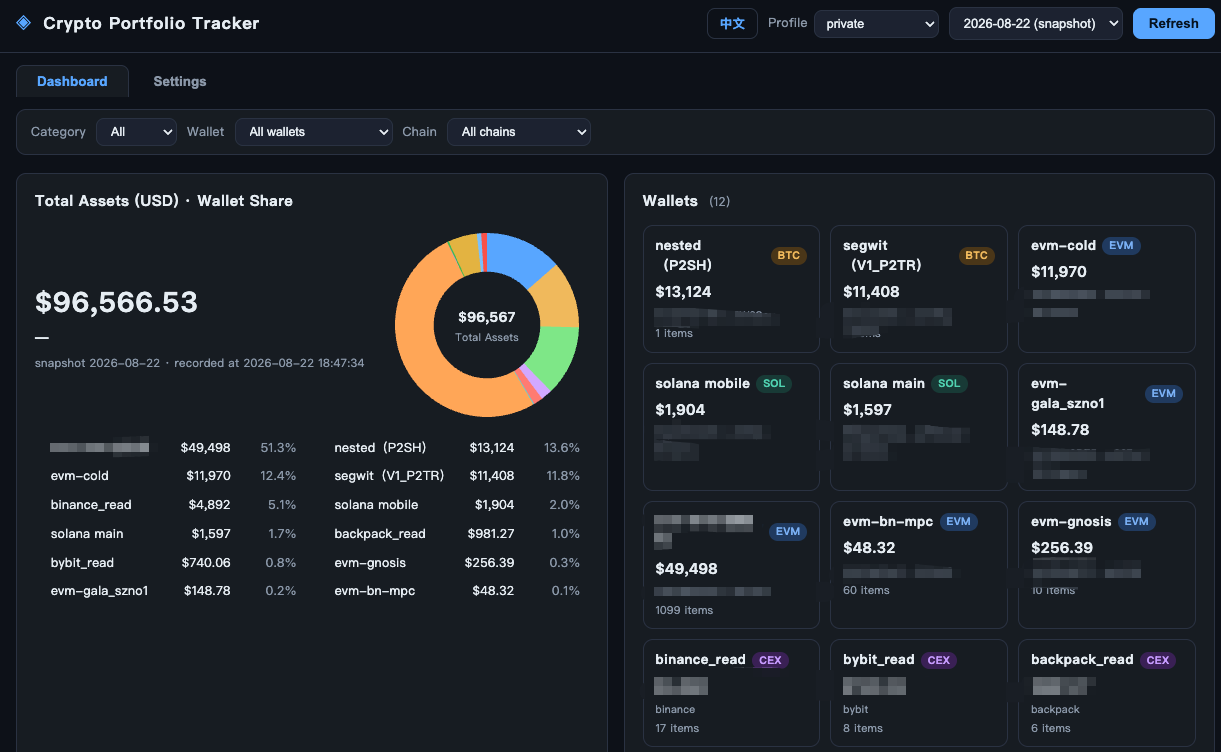
Unofficial project, independently developed and maintained by community members.
I built it because the pain points are real.
EVM assets in DeBank, SOL and staking on-chain, BTC in a block explorer, plus Binance / Bybit / Backpack — each with its own app. Checking "how much do I actually have" meant hopping between six pages, and it was easy to miss a wallet along the way.
This plugin puts all of it on a single screen.
Some money is genuinely invisible: native Solana stake accounts (getParsedStakeAccounts misses them), Hyperliquid L1 staked HYPE and spot balances, exchange earn/funding accounts. None of these are plain SPL/ERC-20 tokens, so ordinary tools never read them.
This plugin digs them out and prices them into your total — including the 12.1 SOL staked in the account above and the ~318 HYPE staked on Hyperliquid.
DeBank lists plenty of fake tokens — ETHG, for example, is a phishing token with a manipulated price that once inflated one account by $570K.
One-click blacklisting: every token you blacklist is removed from totals, trends and historical snapshots instantly.
Without history there's no peace of mind.
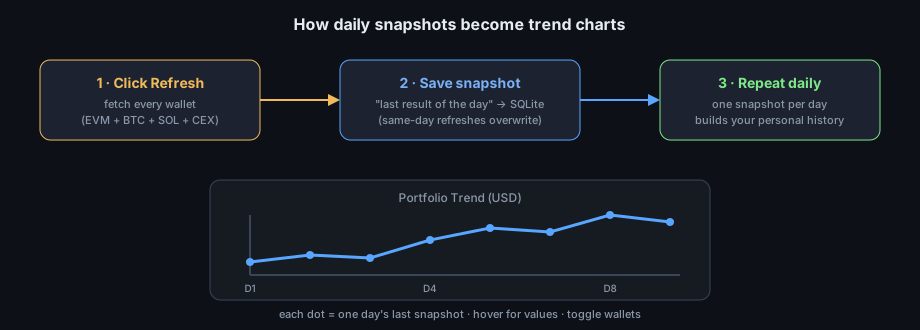
Every refresh saves the last snapshot of the day (SQLite, deduplicated by day); over time it draws a trend line that is uniquely yours:
<exchange>_read).debank-pro (badged "PAID", with a registration link) and free keyless debank-public fallback; CEX rows always show Binance/Bybit/Backpack with "get API key" links to each exchange. Each source displays when it last succeeded.default profile ships with public template wallets (vitalik.eth, genesis BTC, public SOL, public DOGE, public ADA) and empty keys; each profile can be renamed — its snapshots move with it — and keeps its own daily refresh time; your private wallets and keys live in a separately named profile with its own snapshot history.127.0.0.1 and masks API keys in its responses; writes are refused for cross-site requests (Sec-Fetch-Site: cross-site, foreign or opaque Origin, non-JSON bodies) and refresh is rate-limited to one run per minute. Snapshot history is kept as a 90-day window plus one per month, so the database does not grow without bound.Every box in the diagram is a real data pipeline:
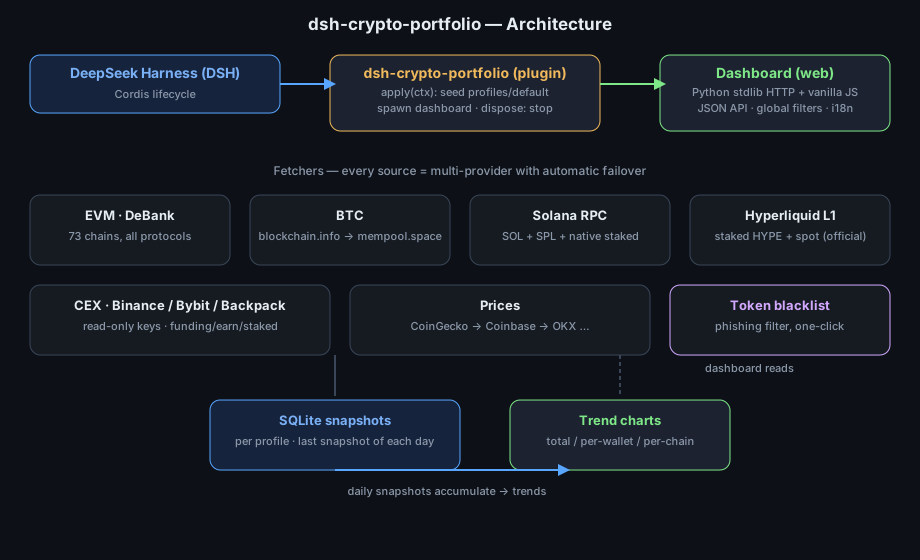
Not a wrapper — a real plugin:
dsh.bundle manifest (cordis.patch.yml), so it installs with dsh plugin add.apply(ctx) hooks into the Cordis lifecycle: seeds user-local profiles/default from public templates on first run, spawns the dashboard as a child process, and stops it cleanly on ctx.on('dispose').GET /api/refresh, /api/history, /api/tokens, ...) that an agent can call directly, in addition to the web UI.This repository contains no private keys, no private wallets, no balances — tracker/config.py ships with WALLETS = [] and empty keys. All private configs live in git-ignored local profiles/. Clone it, review it, run it with confidence.
dsh 0.1.1-rc.2 (or a compatible release within the same pre-release line)
and Node ^22.19.0 || >=24.0.0 — the range DSH itself declares.
Python 3.9+ with two pip packages:
pip3 install requests pynaclThese are ordinary runtime dependencies, not vendored, so pip can pick the
build that matches your platform.
Installs prebuilt code and needs no build permission:
dsh plugin --profile demo add dsh-crypto-portfolio
dsh --profile demopnpm pack # produces dsh-crypto-portfolio-0.1.0.tgz
dsh plugin --profile demo add ./dsh-crypto-portfolio-0.1.0.tgzdsh plugin --profile demo add github:0xRabit/dsh-crypto-portfolio#<commit-sha>This package is plain JavaScript + Python with no build step, so its
prepare is a no-op and pnpm does not need you to allowlist a build script —
unlike plugins that ship TypeScript sources. Pin a commit SHA anyway, so a
later push cannot change what runs on your machine.
dsh --profile demo --dump-config # look for: # == dsh-crypto-portfolioIf that line is missing, the bundle did not activate — the package installed as a
plain dependency instead. Re-run the add and check the warning it printed.
A patch replaces the whole config of a row, so restate every key you need.
Put this in $DSH_HOME/profiles/demo/cordis.patch.yml:
- id: portfolio-tracker
  name: dsh-crypto-portfolio
  config:
    port: 8199
    host: 127.0.0.1
Or set PORTFOLIO_PORT in the environment.
python3 run.py --init-template --port 8080 # seeds profiles/default from public templatesprofiles/default/ sources.json + wallets.json (public template, auto-seeded)
templates/ public example configs (no secrets)
tracker/ backend fetchers (debank/btc/solana/hyperliquid/cex/prices)
static/ web dashboard (vanilla JS, no external deps)
run.py / fetch.py web server / CLI snapshotMIT — see LICENSE.
CLASSIFICATION EVIDENCE
系统优先读取 GitHub Topics,再与站内分类词典和词根规则比对。当前命中: 无有效分类标签。
deepseek-ai
DeepSeek Harness: Everything is a Plugin.

anywhere-labs
为 DeepSeek Harness (DSH) 插件生态打造的现代化桌面端解决方案。万物皆「插件」,桌面本身也是「插件」。

awesome-dsh-plugin
A curated list of plugins for DeepSeek Harness (dsh) · DeepSeek Harness 插件精选列表